

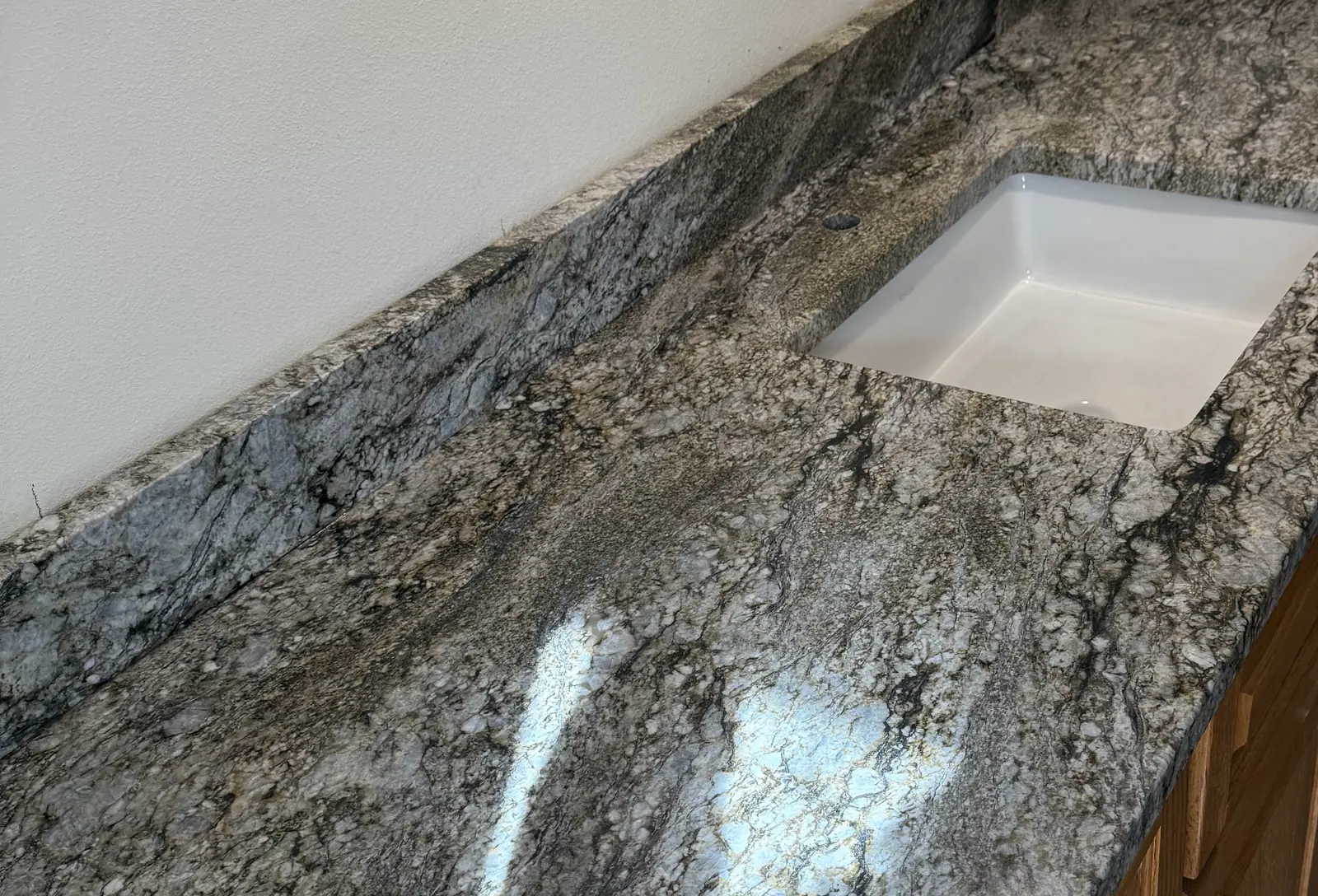
A thin line has appeared in your granite and your stomach dropped. Before you price a new countertop, slow down: a good share of the lines homeowners report as cracks are natural fissures, which were in the slab the day it was cut and are not damage at all. The two look nearly identical in a photograph and behave nothing alike. Here is how to tell which one you have, in about two minutes, with a flashlight and a fingernail.
What a fissure is, and why your slab has them
Granite and quartzite form out of minerals that crystallize at different rates under heat and pressure. Where two mineral bands meet, the stone can part very slightly along that boundary. That partial separation, filled and polished flat long before the slab reaches a kitchen, is a fissure.
The part that matters is its direction. A fissure follows the stone’s own pattern, because it is a product of that pattern. It runs with the veining, bends when the veining bends, and tends to fade out rather than stop at a point. It has been there since the slab was quarried.
A crack is the opposite in every way. It is new, it is mechanical, and it has no interest in the pattern. Something loaded the stone past what it could carry: an unsupported span, the corner of a cutout, heat concentrated on one spot, a nut tightened from below. A crack takes the shortest path through the material, which usually means cutting across the veining at its own angle.
Natural stone is sold with fissures in it. They are normal, they are disclosed, and a slab with none is unusual rather than better. If someone pointed one out to you on template day, that was honesty, not a warning. There is more on how slabs are picked on our granite countertops and quartzite countertops pages.
Five checks, in the order that settles it
Do them in this order. The first two answer most of them, and all five together take about two minutes.
Run a fingernail across it
Drag a nail perpendicular to the line, not along it. A fissure is polished flush with everything around it, so the nail glides over and you feel nothing. A crack has two edges that no longer sit at quite the same height, and the nail catches on one of them. This one check is right far more often than something so simple ought to be.
Follow it with your eye
Trace where the line goes. A fissure stays inside a band of the pattern and changes direction when the veining does. A crack runs comparatively straight, crosses whatever is in its way, and usually begins somewhere specific: the corner of a sink or cooktop cutout, the edge of a dishwasher opening, a faucet hole.
Put the light low
Turn the overheads off and hold a flashlight almost flat to the surface, shining across the line rather than down onto it. Raking light shows a difference in height instantly. Flat and even means fissure. A shadow along one side means a step, and a step means a crack.
Look at it from underneath
Open the cabinet below and shine the light up at the same spot. A fissure is a surface feature and there is nothing to find. A crack that is worth acting on has usually gone through, and the same line will be waiting for you on the underside.
Mark it and let time answer
Stick a small piece of tape at each end and write the date on it. In six months a fissure will be exactly where you left it. A crack that is moving will have passed one of your marks, and that changes the conversation completely.
If any of that is hard to call, you do not have to call it alone. Send us a photo or ring 206-653-4479 and we will tell you which one it is before anyone books anything. What a visit actually covers is on our countertop repair page.
What you found, and what it means
Treat this as a starting point rather than a diagnosis. Two lines that photograph identically can be very different once someone has a hand on them.
| What you see | Most likely | What it usually needs |
|---|---|---|
| Thin line following the veining, nail glides straight over it | Natural fissure | Nothing at all |
| Line that catches a nail and crosses the pattern at its own angle | Crack | Find what is loading the stone, then fill |
| Line starting at the corner of a sink or cooktop cutout | Crack from a cutout with too little support | Support underneath first, then the fill |
| Straight line across the full depth of the counter, identical on both sides | Usually a seam that has opened, not a crack | The joint is cut back and re-bonded |
| Fine line visible from one angle only, with no depth to it | Surface scratch | Polishing, which depends on the material |
| Cloudy white mark with no depth, on granite | A stun mark from an impact | Normally cosmetic, worth a look |
| Any hairline in a quartz countertop | Not a fissure, because quartz has none | Always worth checking properly |
The fourth row sends more people down the wrong path than any other. If the line runs the full depth of the top in one clean sweep and reads the same from above and below, read a countertop seam that opened before you treat it as a crack.
Quartz is the one that cannot have a fissure
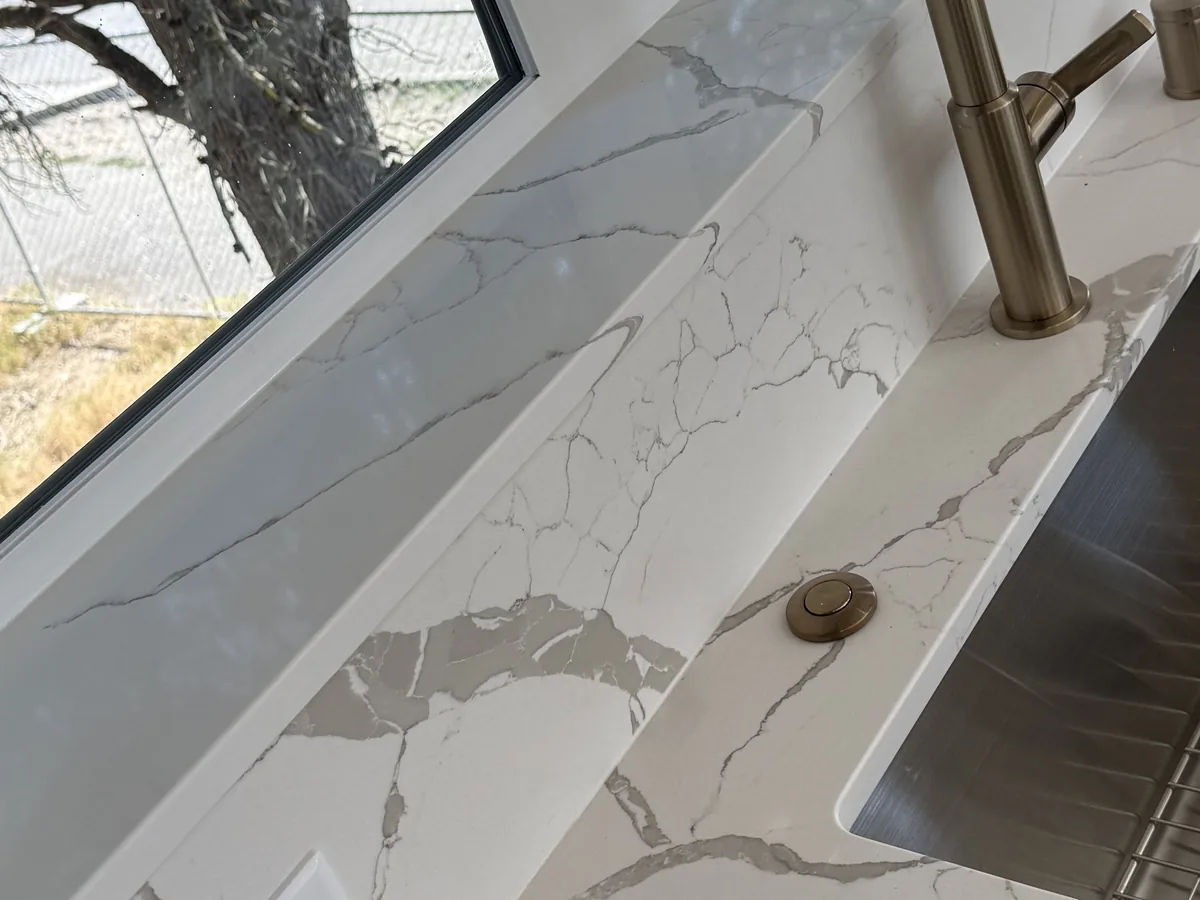
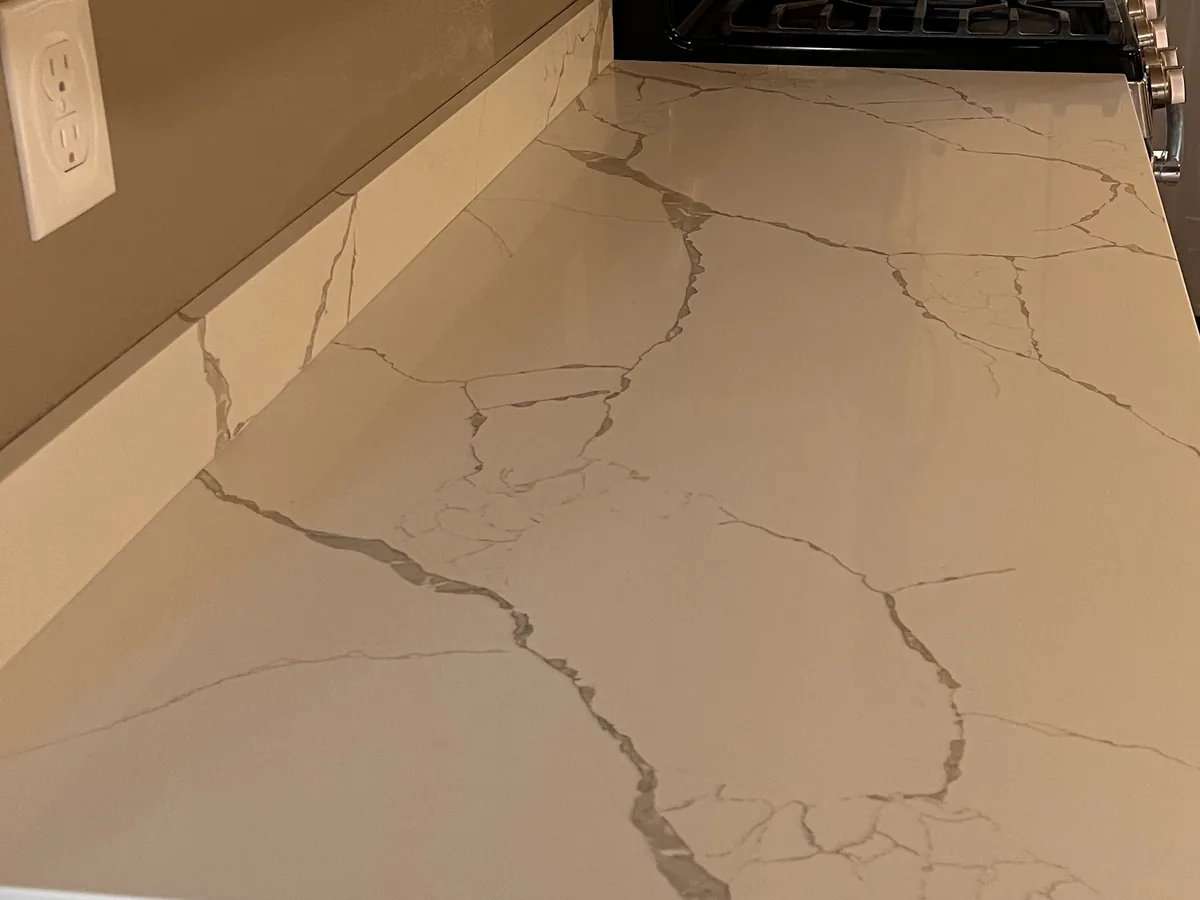
This is where the subject catches people out. Quartz countertops are engineered: ground stone bound with resin and pigment, pressed and cured in a plant. The veining in quartz was designed and laid into the slab on purpose. Some of it looks remarkably like a web of fine cracks, which is exactly why it gets reported as damage by people who have just moved in.
What quartz does not have is a natural fissure, because it never formed naturally. So a line in a quartz top is one of three things: part of the printed pattern, a real crack, or a scratch. The fingernail and the raking light sort those out the same way they do on granite. The answer matters a little more here, because a crack in a plain quartz has nothing to hide behind. There is more detail on our quartz countertop repair page.
The flip side is worth knowing if you are still choosing material. Because quartz patterns are manufactured, two slabs with the same name resemble each other far more closely than two slabs of the same granite ever will. If this whole question would keep you up at night, that predictability is a genuine argument for quartz.
If you landed here while planning a remodel rather than chasing a line, our budget planner will give you a range for your own kitchen in about a minute, before anyone calls you.
When a fissure does deserve attention
Rarely, and then only in three situations.
The first is location. A fissure crossing the narrow bridge of stone in front of a sink, or the thin strip beside a cooktop cutout, sits in the weakest part of the whole top. It is still not damage. But that is exactly where a crack would begin if one ever did, so it is worth knowing it is there, not sitting on the counter at that spot, and not leaning on it while you reach for something.
The second is a fissure that has opened enough to hold water or catch crumbs. Once it is no longer flush it is no longer only a fissure, and the point of the raking light test is to catch that early.
The third is a fissure that was never filled well at the plant and has slowly taken up oil, so it reads darker than the stone around it. That is a cleaning and sealing conversation rather than a structural one, and we covered it in countertop stains and etch marks.
What moves the cost
We do not publish a price for this, and anyone quoting a crack repair from a text message is guessing. Having a line looked at costs you nothing, and if it turns out to be a fissure there is nothing to quote in the first place.
When it is a crack, the number moves with the cause rather than the length of the line. Filling a hairline in a well supported top is a short visit. Filling the same hairline after cabinets have been releveled, support has been rebuilt under a cutout, or a sink has been dropped out of the way is a different day of work entirely. That is what the visit settles, and countertop repair sets out what is included in one.
By material, briefly
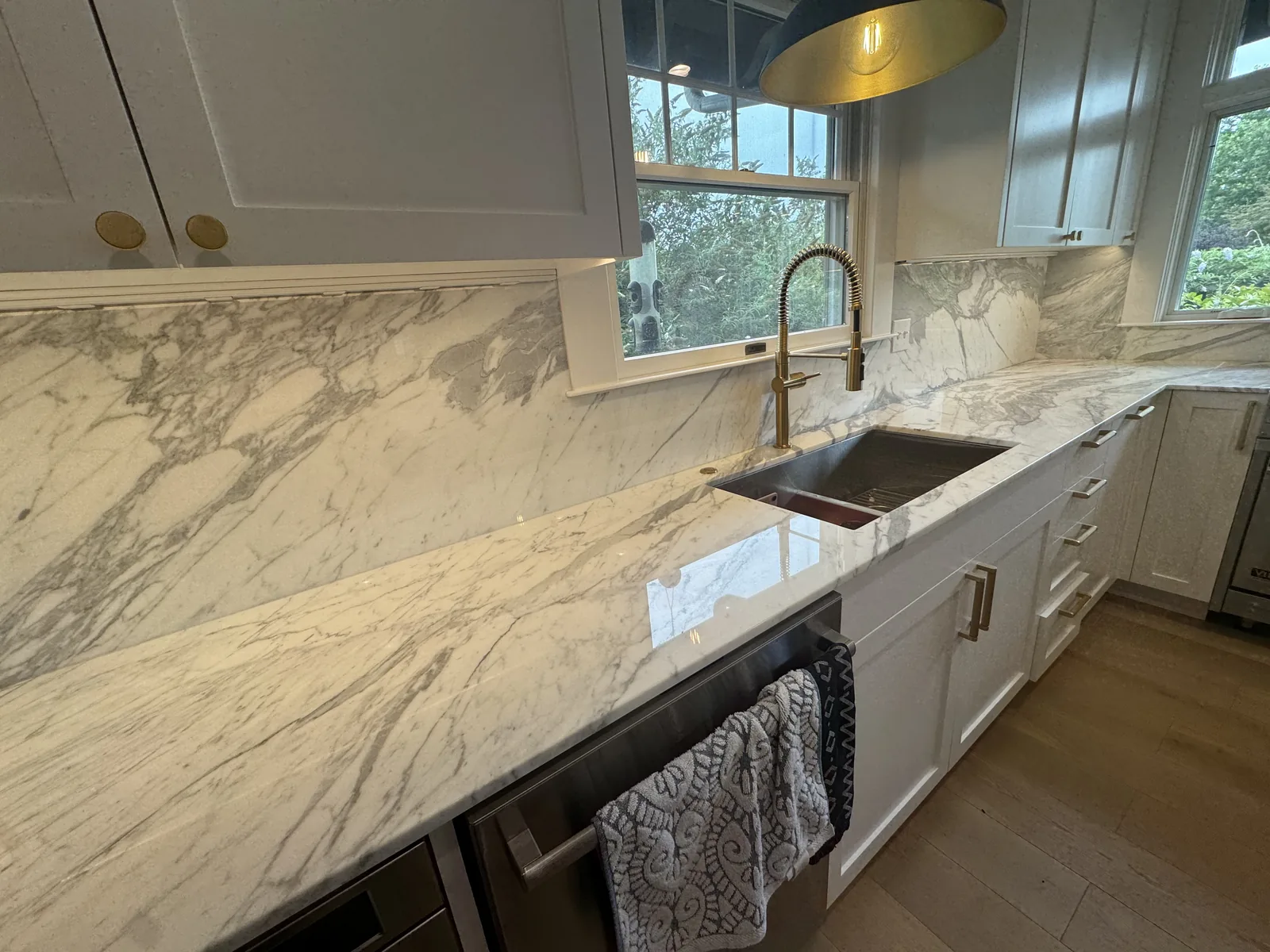
Granite has the most fissures of the four and hides a repair best, because the pattern is busy enough to absorb one. Quartzite is the hardest of them and its fissures tend to be long and fine, running with the layering. Marble has them too, though etching is almost always reported before any line is. Quartz has none, by definition.
There is more depth on each at granite countertop repair, quartzite countertop repair and quartz countertop repair. If you are in Snohomish or King County we cover you, including Lynnwood, Seattle and Kent.
Frequently asked questions
Is the hairline in my granite a crack or a natural fissure?
Run a fingernail across it, perpendicular to the line. A fissure is polished flush with the surface and the nail glides over it, and it follows the veining rather than cutting across it. A crack catches the nail on one edge, crosses the pattern at its own angle, and usually starts at a cutout corner or an unsupported span. If the nail test is ambiguous, hold a flashlight almost flat against the surface: raking light shows a step immediately.
Do fissures in granite get worse over time?
No. A fissure is a feature of how the minerals formed and it has already been there for a very long time. It does not spread, lengthen or open on its own. If a line in your stone has visibly changed, grown past a mark you made, or started catching a fingernail where it did not before, then it is not behaving like a fissure and it is worth having someone look at it.
Can a natural fissure be filled or repaired?
It normally does not need anything, because it is already flush and sealed from the factory. The exception is a fissure that was poorly filled at the plant and has since opened enough to hold water or darken with oil. That one can be cleaned out, refilled with tinted resin and polished back level, which is the same process used on a crack. Nobody should be selling you work on a fissure that is sitting flat and clean.
Does a fissure mean I was sold a bad slab?
No. Fissures are a characteristic of natural stone rather than a defect in it, and slabs are sold on that basis across the industry. A granite or quartzite with no fissure at all is the unusual one. What you should expect is that anyone selling you a slab points them out before fabrication, so you know where they sit and can decide how the piece gets laid out.
Can quartz countertops have fissures?
They cannot. Quartz is engineered from ground stone, resin and pigment, so it has no natural mineral boundaries to part along. Any line you can see in a quartz top is either part of the printed pattern, a scratch, or a genuine crack. The same fingernail and raking light checks will tell you which, and because engineered veining is often drawn to look like fine cracking, the pattern is the answer more often than people expect.
There is a fissure right in front of my sink. Should I be worried?
Worth knowing about rather than worried. The strip of stone between a sink cutout and the front edge is the narrowest part of the whole top, so anything running through it sits in the weakest spot. It is still not damage and it does not need fixing. What it does mean is that you should not sit or kneel on the counter there, and should not rest anything heavy on that strip. Send us a photo if you want a second opinion on it.
Send two photos and we will tell you which it is
Two photographs settle nearly all of these: one taken straight down on the line in normal light, and one taken from the side with a flashlight held almost flat across the surface. If you can, add a third from inside the cabinet underneath. Text or email them with the material if you know it, and we will tell you honestly whether you are looking at a fissure, a crack or a seam. Call 206-653-4479, use the contact page, or if your question is really about replacing the top, start with the budget planner.
What could your
countertops cost?
Answer a few questions about your space and material and get an estimated range in about two minutes. Your formal quote follows a laser template and a review of the scope.
Your ideas in. A clearer next step out.
Rather talk it through? 206-653-4479 ↗︎What would you like to change?
Which material are you leaning toward?
Build my countertop estimateChoose your details and see your estimated range.
Related reading.
Repair or replace your countertop? 7 damages compared
A chip at the sink, a crack over the dishwasher, a seam that opened. See which countertop damage is worth repairing, when replacement is the better buy, and what moves the cost.
Read article ↗︎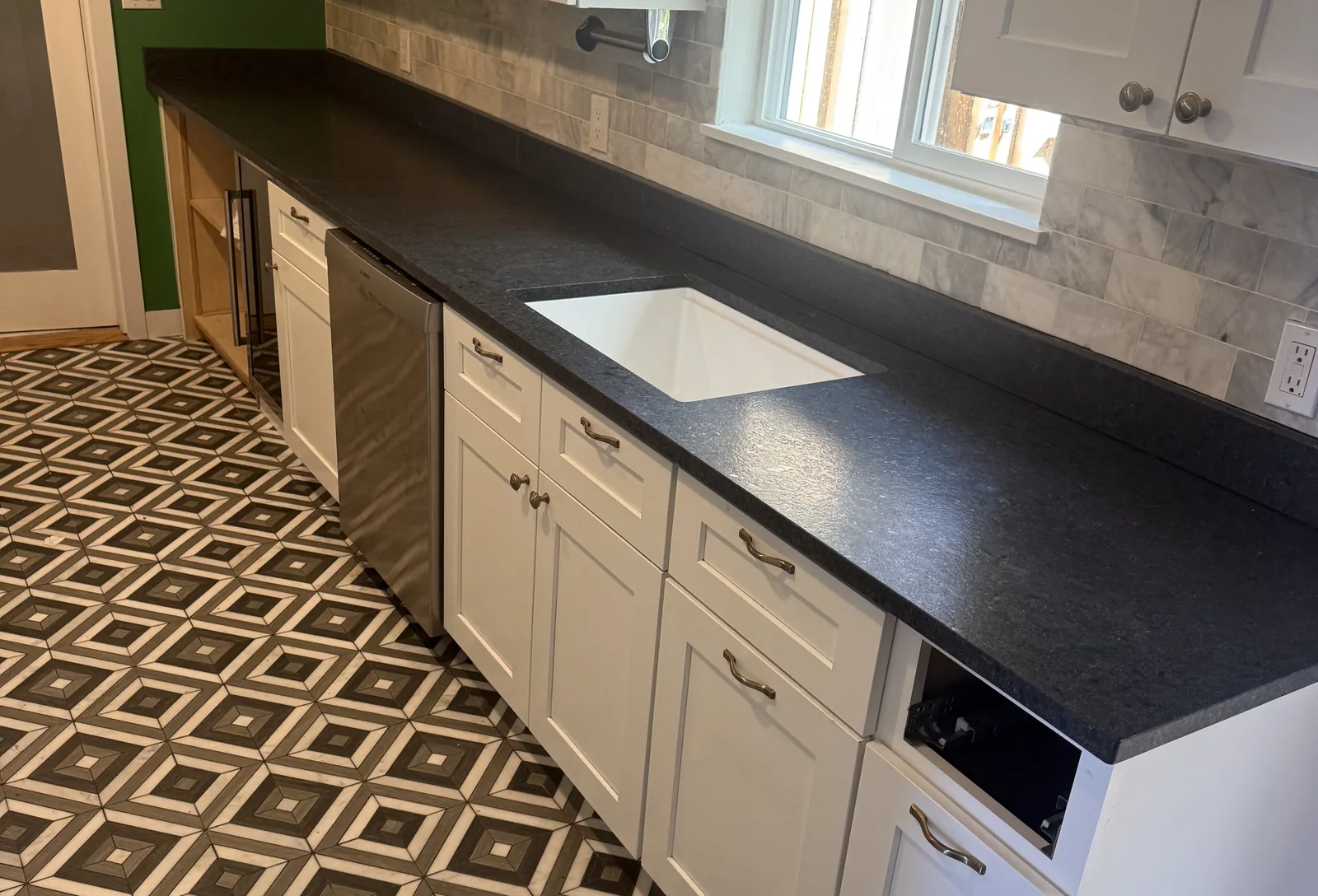
Why countertops crack over the dishwasher and at cutouts
A crack in front of the dishwasher, or out of a cutout corner, is almost never a bad slab. It is an unsupported span, heat from the appliance and hardware pressing on the stone. How to read where it started, what a repair can honestly do, and what prevents the next one.
Read article ↗︎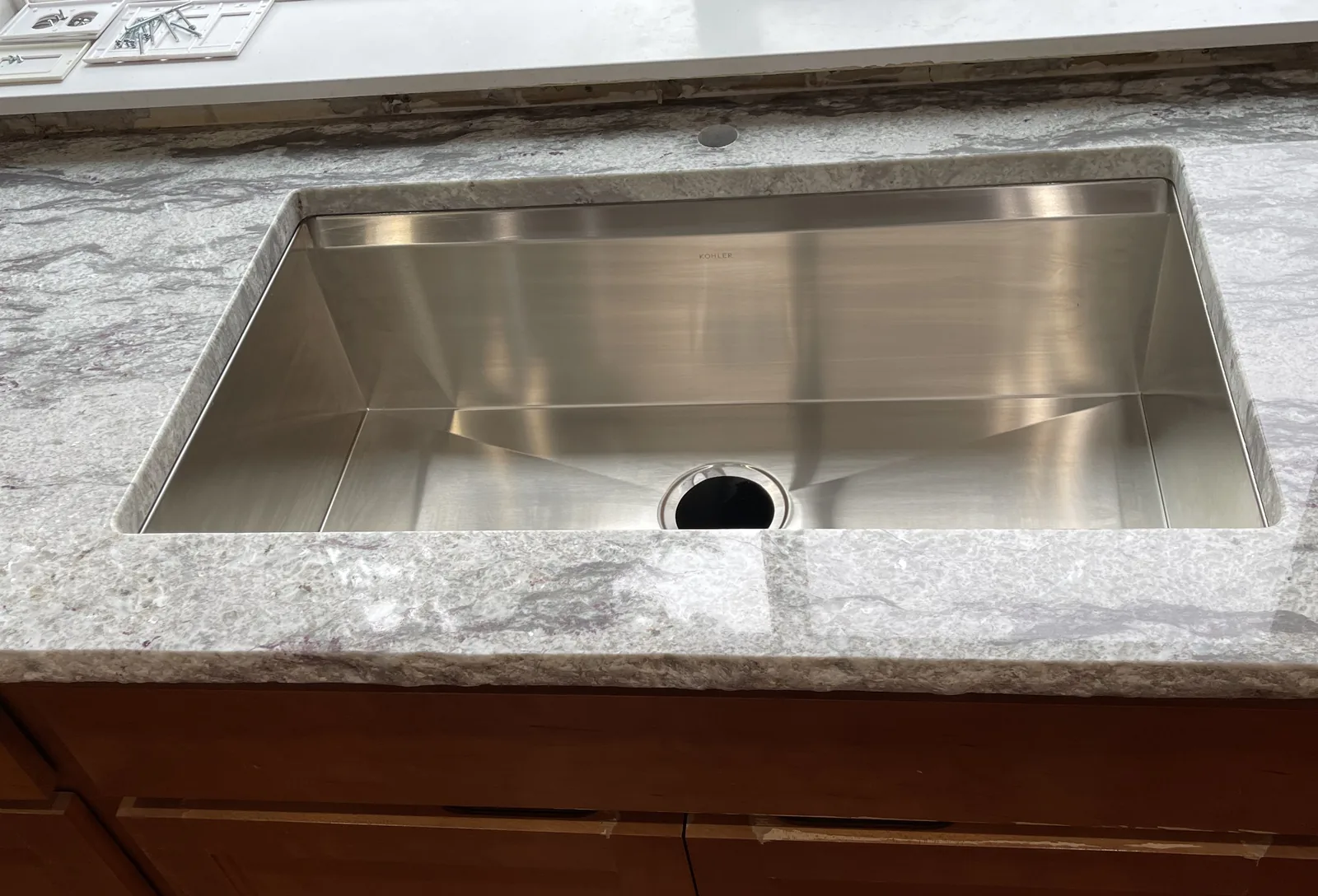
Your undermount sink came loose: why it happens and what fixes it
A sink that has dropped, tilted or pulled away from the stone is a mounting failure, not a stone failure. What to do in the first ten minutes, the seven things that cause it, and what a proper re-set actually involves.
Read article ↗︎Bring your ideas.
We’ll help with the next step.
Choose the next step that feels right for you.