

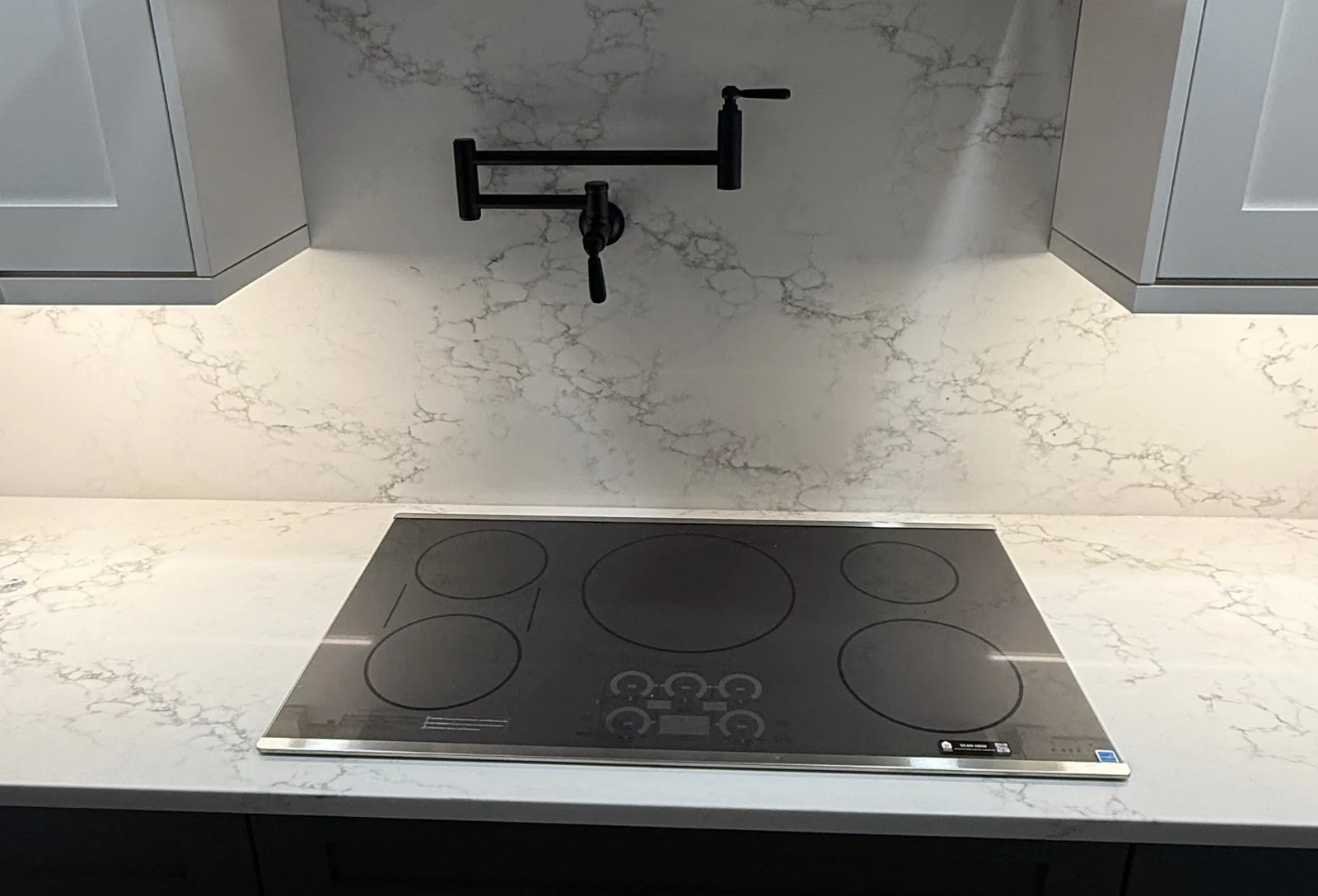
A crack that runs across the countertop in front of the dishwasher, or that walks out of the corner of a cooktop opening, almost never means the stone was defective. It means that strip of stone was the thinnest, least supported, hardest working part of the whole top, and something finally asked more of it than it could give. Where the crack starts tells you most of what you need to know about fixing it.
Cracks start where the stone runs out
A countertop is immensely strong as a continuous, fully supported field of stone. It turns weak exactly where we had to take stone away or leave it hanging.
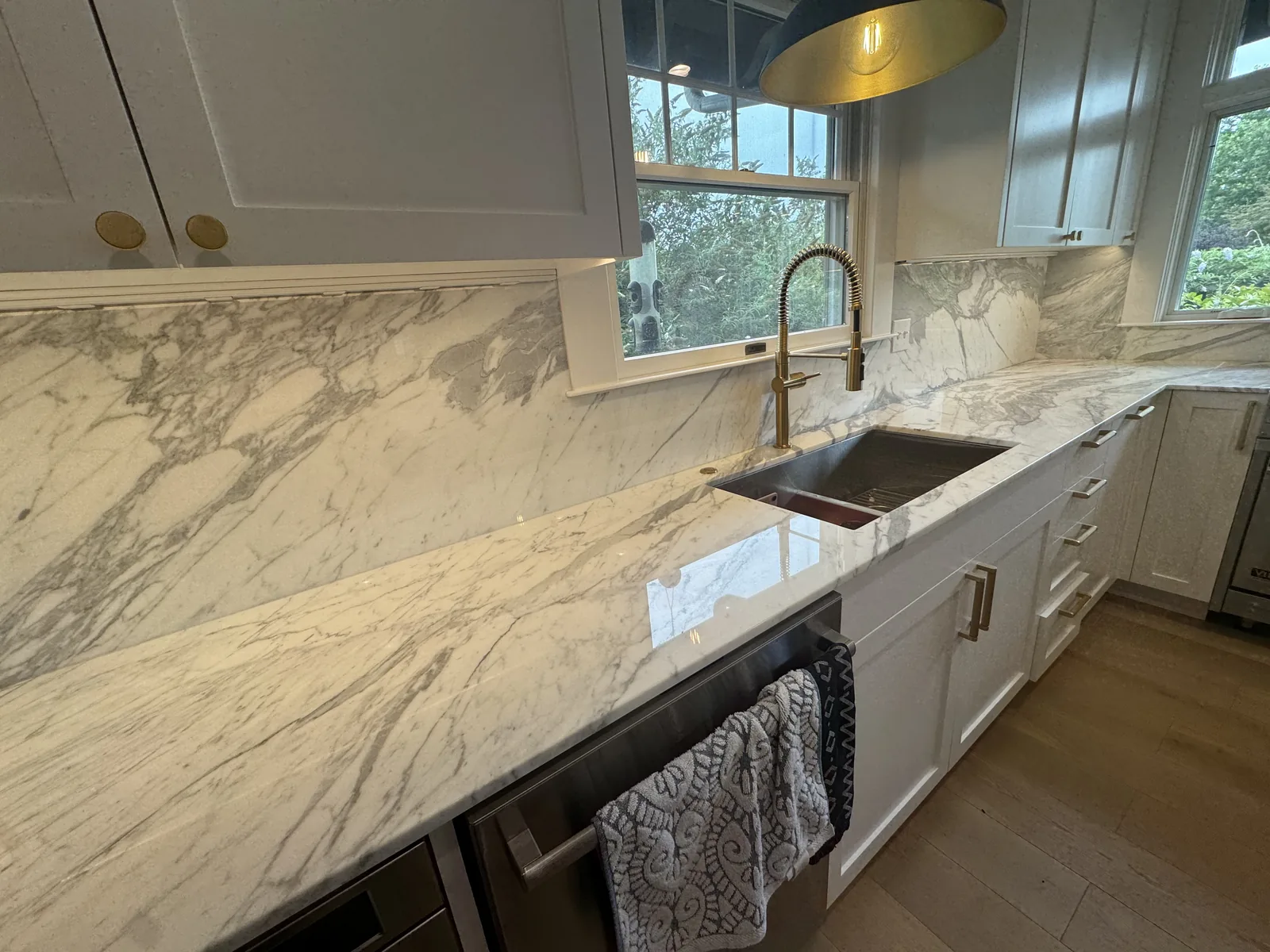
The run over the dishwasher is the clearest case. There is a cabinet on the left, a cabinet on the right, and between them an opening roughly two feet wide with nothing underneath but the appliance and air. The stone bridges that gap on its own.
The sink is the second. Between the bowl and the front edge there is often only three or four inches of stone left, and that narrow bridge is where people lean and where the weight of a loose sink starts to pull. The cooktop opening is the third, because of its inside corners: any inside corner gathers stress, which is why a cutout corner should be cut with a radius rather than a sharp ninety degrees. A sharp corner is a starting line.
Why the dishwasher usually deserves the blame
Three things stack up over that one opening, and any two of them together are enough.
The first is the span. The second is heat: a dishwasher dumps hot, wet air at the end of its cycle, and on many machines it goes straight up through the top of the door into the underside of the stone. One narrow band of countertop gets hot while the stone on either side stays at room temperature. The warm band wants to grow, the cold stone will not let it, and that argument has to end somewhere. Quartz minds this most, because it is stone held together with resin, and every quartz manufacturer warns against sustained heat.
The third is the fastening, and almost nobody checks it. A dishwasher has to be secured so it cannot tip when a loaded rack is pulled out, and with a stone top that means the side cabinets, using the brackets that come in the box. What we still find, usually after an appliance swap rather than a new kitchen, is brackets screwed or wedged up into the underside of the countertop. That is a hard point load on the thinnest, hottest, least supported piece of stone in the room. If your crack appeared within a few months of a new dishwasher, start there.
If you are looking at one of these, send a picture before you decide anything. Top Granite countertop repair covers greater Seattle and the Eastside, and the first look costs nothing: call 206-653-4479 or use the contact form and attach the photos.
Read the crack before you call anyone
Where it sits, and which way it runs, narrows the cause down fast. This is roughly how we sort these calls before anyone has driven out to look.
| Where the crack is | Usual cause | What it usually takes |
|---|---|---|
| Straight across the run, in line with the dishwasher door | Unsupported span plus heat, often with a bracket pressing up into the stone | Remove the load, support underneath, then fill from the top |
| Out of an inside corner of the cooktop opening, at an angle | A corner cut too sharp, working with heat from the appliance | Reinforce and fill, and sometimes a sliver cannot be saved |
| In the narrow bridge between the sink and the front edge | Flex in a thin section, very often after the sink itself came loose | Fix what is under the sink first, then the stone |
| Following an existing seam, with the seam opening rather than the stone breaking | Movement in the cabinets, or a seam placed over an opening | Clean it out, re-level, re-bond the seam |
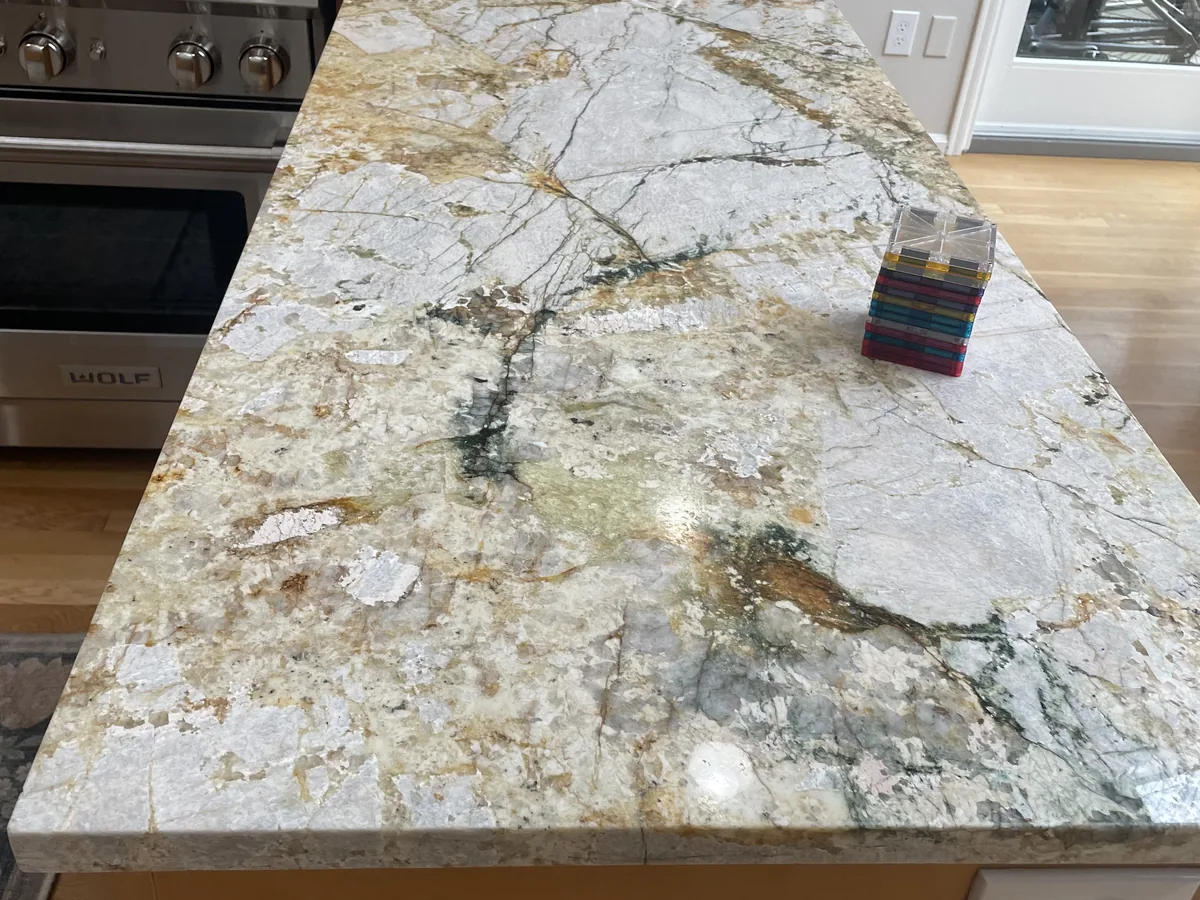
| A hairline that follows the veining and does not catch a fingernail | Most likely a natural fissure, which is not damage | Usually nothing at all |
| Short radiating lines around a faucet hole | An overtightened nut loading the stone from below | Release the load, then fill |
| Anywhere, appearing within weeks of a new appliance | Mounting hardware bearing on the underside | Deal with the hardware, or the repair will not hold |
Two tests cost you nothing. Run a fingernail across the line: a real crack catches, a fissure does not. Then put painter's tape at each end and write today's date on it. If the crack has grown past the tape in a month it is moving, and moving changes the plan. If the line sits in the bridge in front of the sink, check the sink too, because a sink that has come loose loads that strip of stone every time the bowl fills.
What a crack repair can and cannot do
The filling is the part people picture, and it is the last and least important step. Fill the line while the cause is still in place and you have a repair with a countdown on it: it opens again, usually in the same season.
The real work happens underneath. Take out whatever was loading the stone, then give the span something to sit on: a cross support between the two cabinets, a bar carried on the cabinet sides, or reinforcement bonded across the break. Only then does the crack get cleaned out, filled with a color matched resin, cured, razored flat and polished back.
Here is the honest part, and we would rather say it before the visit than after. A good fill on a busy granite can be genuinely hard to find afterward. On a plain white quartz, in daylight, you will still know where it is. Anyone promising an invisible repair on a plain color has not seen your countertop yet. A repair buys you a top that is sound, sealed and far less noticeable, not a new one.
Sometimes it has gone too far. A crack through the full depth in more than one place, or one through the sink bridge that has already moved, is a replacement conversation. Our post on repair or replace, with seven kinds of damage compared, walks through where that line sits, and the budget planner gives you a range for your own kitchen in a couple of minutes.
What to do today, before anyone comes out
Take the heat off that span: stop using the heated dry setting and crack the dishwasher door open at the end of the cycle instead. Take the weight off too, with nothing heavy parked on the stone over the opening. Between them, those two habits remove the loads still working on the crack while you wait.
Do not glue it. Hardware store cyanoacrylate wicks deep into a crack, cures the wrong color and the wrong hardness, and has to be ground out before a proper repair can start. While you have a flashlight out, open the dishwasher door and look up at the top edge of the opening: if you can see brackets or screws going up into the countertop rather than sideways into the cabinets, you have probably found your cause, and that is worth telling us on the phone.
Keeping the next one from happening
Most of this is decided on install day. The dishwasher gets side mounted to the cabinets, never fastened to the stone. The span over it gets a support, which costs almost nothing while the cabinets are open and is awkward to add later. Inside corners get a radius, seams land over cabinet walls rather than over appliance openings, and a thin bridge in front of a sink can be reinforced from underneath while the piece is still in the shop. None of it is exotic: it is the difference between a top that was planned and a top that was cut to fit.
What moves the cost
We do not publish a price for crack repair, and you should be wary of anyone who quotes one sight unseen, because the gap between the easy version of this job and the hard one is wide. Three things move it.
How much of the fix is structural. A crack that only needs filling is one visit. One that needs the dishwasher pulled, a support built and the stone re-levelled is a different day of work.
Where it is. A crack in open counter is reachable. One running into a cutout corner, under a cooktop or behind a sink means appliances and plumbing come out first.
The color. A fill disappears more easily into a busy natural stone than into a solid white, which is the opposite of what most people expect.
Material matters here too, and our pages on quartz repair and granite repair go into how each one behaves. We take these calls across the area: see countertop repair in Lynnwood for how a local visit runs. Anywhere else, call 206-653-4479.
Frequently asked questions
Why did my countertop crack over the dishwasher?
Almost always a combination rather than one cause. The stone spans the dishwasher opening with no support under it, the machine vents hot wet air into that same strip at the end of every cycle, and in many kitchens the dishwasher has been fastened up into the underside of the stone instead of sideways into the cabinets. Any two of those together are enough. If the crack showed up soon after a new dishwasher went in, look at the brackets first.
Can a cracked countertop be repaired, or does it have to be replaced?
Most single cracks are repairable, and the countertop stays where it is. The work is removing whatever caused it, supporting the span underneath, then cleaning the crack out and filling it with a color matched resin that is cured, levelled and polished. Replacement becomes the better buy when the stone is cracked through in more than one place, when the crack runs through the narrow bridge in front of the sink and has already moved, or when a piece has broken away and is gone.
Is a hairline in granite a crack or a natural fissure?
Run a fingernail along it. A crack catches the nail and usually crosses the veining at its own angle. A fissure follows the veining, feels smooth, and has been there since the slab was cut. Fissures are a characteristic of natural stone, not a defect, and they do not need fixing. If you are not sure, mark both ends with tape and a date and see whether it travels.
Will the repair be invisible?
No, and we will not tell you otherwise. On a busy granite or a strongly veined quartzite a good fill is very hard to find. On a plain white or a solid color quartz, in daylight, you will be able to see where it was if you look for it. The point of the repair is a countertop that is structurally sound and sealed, and much less noticeable than an open crack.
Can I keep using the kitchen while I wait?
Usually yes, with two changes. Stop the heated dry cycle on the dishwasher and prop the door open at the end instead, and keep weight off the cracked span. If the crack is in front of the sink, stop leaning on that edge as well. If water is getting down through the crack into the cabinet, that moves it up the queue, because a swollen cabinet deck turns a stone repair into a cabinet job too.
Do you repair countertops you did not install?
Yes, and most repair calls are on work from other companies. Send photos first, including one from inside the cabinet looking up, because what we are really trying to see is how the stone was supported and what is bearing on it. We will tell you what we think before anyone schedules a visit.
Send a photo and we will tell you what it is
A crack is the one kind of countertop damage where a description wastes everyone's time and three photographs settle it in minutes: one from above, one with the light raking low across the surface, one from inside the cabinet. Send them through the contact page or call 206-653-4479, and we will tell you whether you are looking at a fissure, a repair or a replacement before anyone comes out. Top Granite is a family business based in Lynnwood, serving greater Seattle and the Eastside, Monday to Friday 8am to 6pm and Saturday 8am to noon.
What could your
countertops cost?
Answer a few questions about your space and material and get an estimated range in about two minutes. Your formal quote follows a laser template and a review of the scope.
Your ideas in. A clearer next step out.
Rather talk it through? 206-653-4479 ↗︎What would you like to change?
Which material are you leaning toward?
Build my countertop estimateChoose your details and see your estimated range.
Related reading.
Repair or replace your countertop? 7 damages compared
A chip at the sink, a crack over the dishwasher, a seam that opened. See which countertop damage is worth repairing, when replacement is the better buy, and what moves the cost.
Read article ↗︎
Countertop stains and etch marks: what comes out and what does not
A stain soaked in and can often be drawn back out at home. An etch mark ate the polish and has to be worked back by hand. How to tell them apart, the water test for your sealer, and what needs a repair visit.
Read article ↗︎
Quartz vs. granite: 7 reasons to consider quartz
Compare quartz and granite for upkeep, appearance, heat, and project fit. Explore seven reasons to choose quartz and plan with Top Granite.
Read article ↗︎Bring your ideas.
We’ll help with the next step.
Choose the next step that feels right for you.