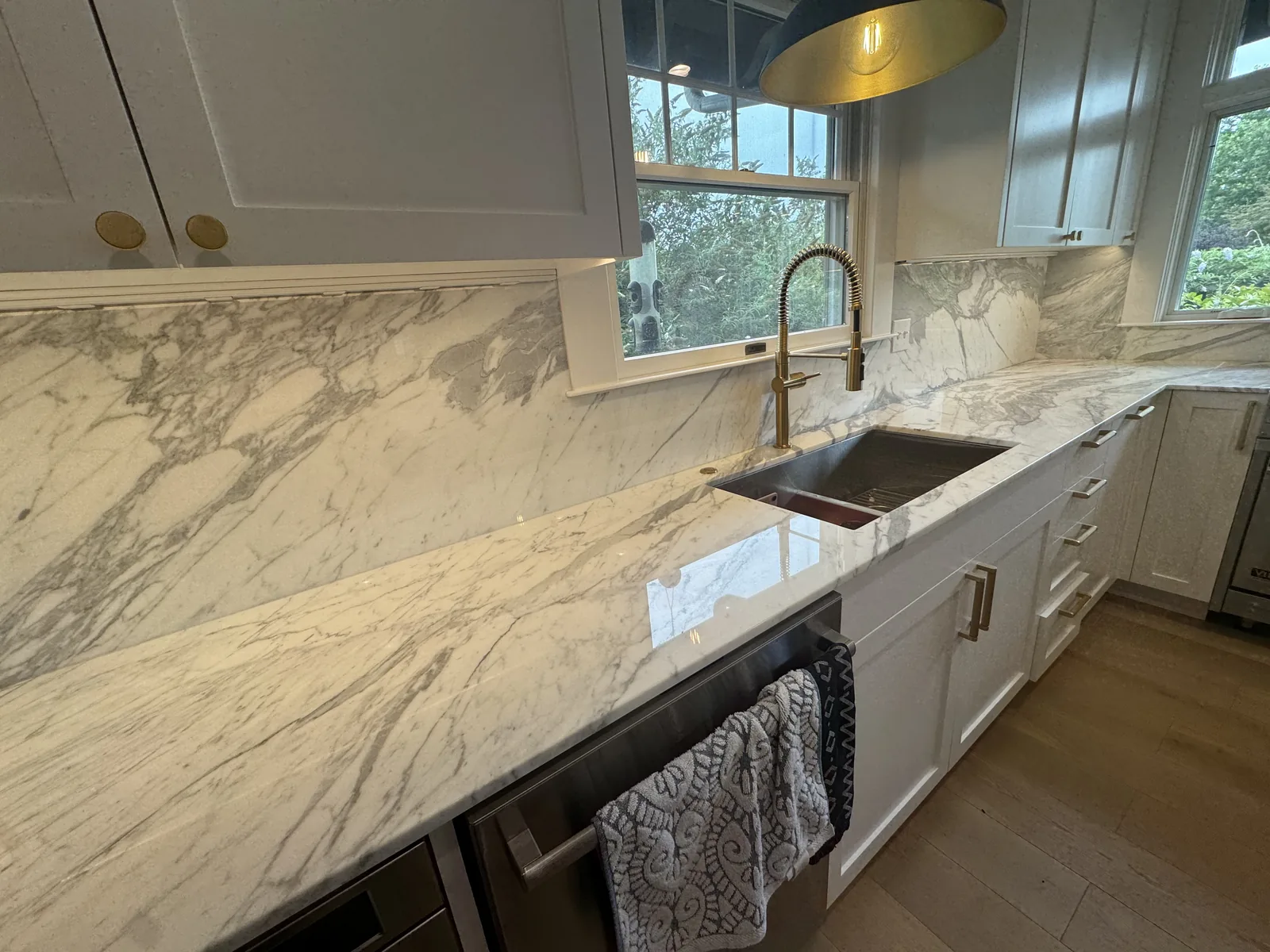

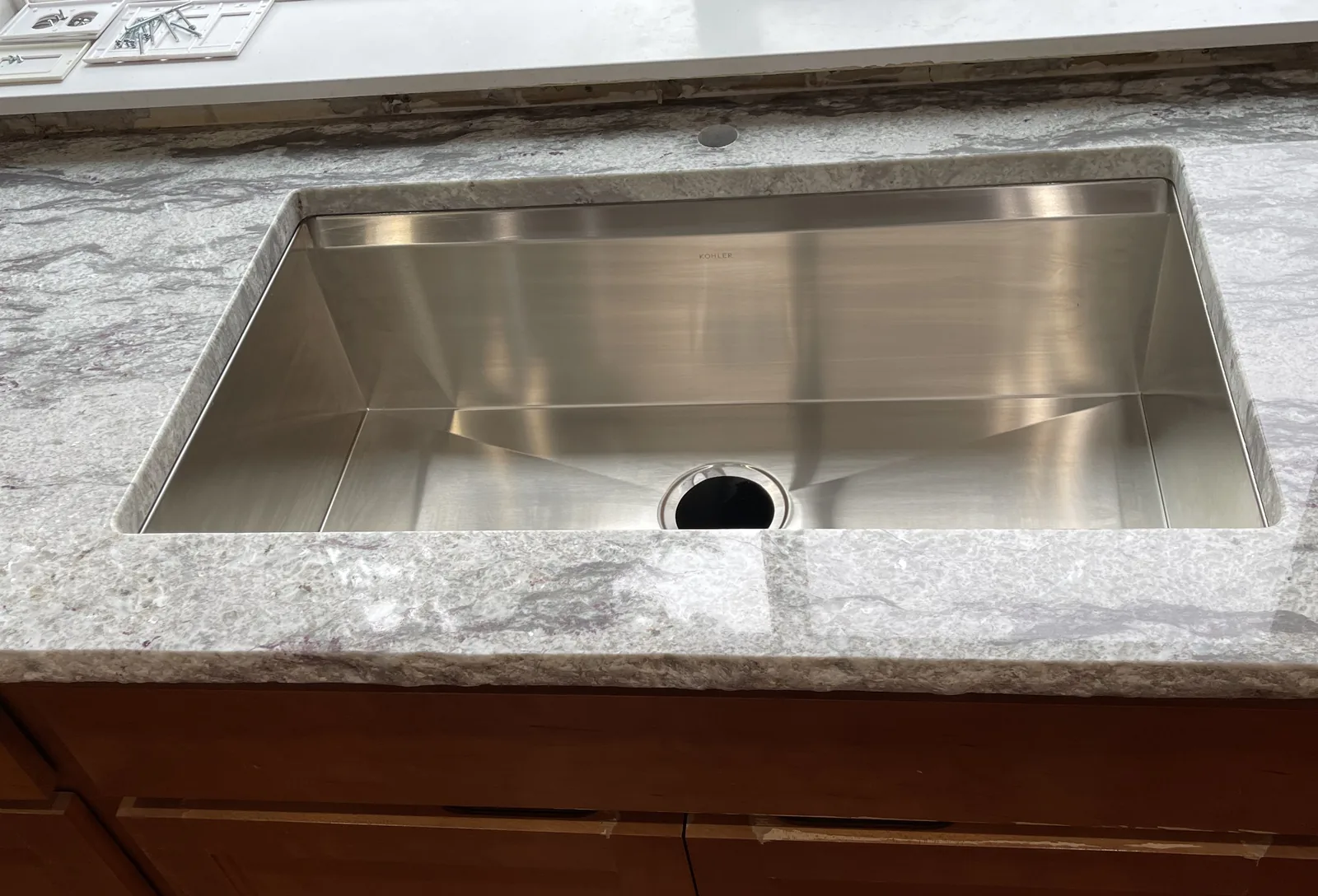
An undermount sink that has dropped, tilted or pulled away from the stone is one of the few countertop problems that is not really about the countertop. Nothing has gone wrong with the slab. What failed is the hardware and adhesive holding a heavy bowl against the underside of it. That is good news, because it is almost always fixable, and urgent news, because a sink hanging by half its supports can take a piece of the stone with it on the way down.
First, take the weight out of it
Before anything else, empty the sink. A full bowl of water is heavier than most people picture, and the whole load is pulling straight down on the one thing that is already failing.
Then stop using it. No dishes stacked in it, no pots filled in it, and no running the garbage disposal, because the disposal hangs off the drain and shakes everything it is bolted to. If the sink has visibly dropped, look underneath: if the drain connection has pulled apart or you see water in the cabinet, shut the supply valves under the sink. If it has dropped far enough to be resting on the cabinet below, leave it there and do not try to lift it back into place. Stone that has lost its support does not appreciate being pushed on.
A piece of wood cut to length and wedged under the bowl, resting on the cabinet floor, is a reasonable stopgap while you wait for someone to look at it. It is a prop, not a repair.
How an undermount sink is actually held up
This is worth understanding, because it explains everything else. An undermount sink hangs below the stone, so nothing holds it from above. Two things carry it instead.
The first is adhesive. The rim of the sink is bonded to the underside of the countertop, usually with a stiff epoxy or a structural silicone, and that bond carries a surprising share of the load while it is intact and dry.
The second is mechanical support: clips, brackets, studs or a rail system anchored either into the underside of the stone or into the cabinet. On a light stainless sink, the clips are there to hold the bowl in position while the adhesive does the work. On a heavy sink they are the structure, and the adhesive is closer to a seal.
Then there is the bead of silicone you can see from the top, around the rim. That is a water seal. It holds nothing up, which is why a sink can be perfectly solid with an ugly bead, and a sink with a beautiful bead can be hanging on by nothing.
Why it let go
What you can see from the kitchen usually points at the cause. Here is how we sort these calls before anyone has been out.
| What you are seeing | Usual cause | What it takes |
|---|---|---|
| A dark line or a gap in the rim seal, nothing moving | The silicone bead has failed, the mounting has not | Clean out and reseal |
| One corner has dropped, the rest is tight | A single clip or anchor let go | Re-anchor that side and re-bond |
| The sink dropped evenly, or fell into the cabinet | The adhesive bond released across the rim | Drop it fully, clean both faces, re-set |
| A heavy cast iron or fireclay sink sagging slowly | It was carried by adhesive when it needed a frame | Build support under it, then re-set |
| Movement that you notice when the disposal runs | A loose anchor plus constant vibration | Re-anchor before the rest follows |
| Standing water or swollen particleboard in the cabinet | The seal has been open for a while | Repair the sink, and deal with the cabinet deck |
| A chip at the cutout rim that appeared at the same time | The stone took load it was never meant to carry | Stone repair alongside the re-set |
Two causes sit behind most of them. Water first: a seal weeping for a year softens everything around it and swells the cabinet deck the brackets are screwed into. Heat second, and it surprises people. Draining boiling water into a stainless bowl heats the rim, the rim heats the adhesive, and adhesive that gets hot and cools a few thousand times is not the adhesive that was installed.
If yours is dropping now, send photographs rather than a description: one from above showing the rim, and one from inside the cabinet looking up at the clips. Use the contact form or call 206-653-4479 and we will tell you which row of that table you are in.
What a re-set actually involves
A proper re-set is a half day of unglamorous work, and the order matters.
The plumbing comes off first: trap, disposal if there is one, supply lines if the faucet has to move. The sink is then lowered out rather than pulled, because pulling drags the rim across the cutout edge, where the stone is thinnest.
Then comes the slow part, which is cleaning. Old epoxy, cured silicone and whatever someone used last time all have to come off both the stone and the sink flange, down to clean material. Adhesive bonds to what it touches, so new adhesive over old adhesive is a repair with a countdown on it.
With the sink out, the cutout rim gets inspected for chips and for hairline cracks running from the corners, because this is the one moment it can be seen from both sides. The mounting hardware is replaced rather than reused, the sink is bonded and clamped into position, and it stays propped from below while the adhesive cures. Only then does the plumbing go back and the top bead get run.
How long it has to cure before you can fill the bowl depends on the product and on the conditions in the room, so we will tell you on the day rather than guess at it here. Rushing that step is how a sink comes loose twice.
Heavy sinks need a frame, not glue
If yours is cast iron, fireclay or a deep apron bowl, read this part twice. A sink like that is heavy empty and considerably heavier full. Adhesive and a few clips can hold it for years and then stop, which is why these failures are so often described as sudden.
Done properly, a heavy undermount sits on something: a frame, a cradle or rails carried by the cabinet, so the cabinet takes the weight and the adhesive only has to seal. If your heavy sink has sagged once and gets re-glued without that support going in, you have bought time rather than a repair. It is the same principle as a cracked span over a dishwasher, which we cover in repair or replace your countertop.
It is also the argument for thinking about sink weight at the start of a project rather than at the end. Our notes on choosing an undermount sink cover what the mounting has to carry.
What moves the cost
We do not publish a price for this, because the gap between the easy version and the hard version is wide. These are the things that move it.
What the sink is made of. A stainless bowl is a different job from cast iron, both to handle and to support. Whether the stone is damaged too. A chip or a crack at the cutout turns one job into two, on granite or on quartz. What is under there. A sound cabinet deck is straightforward; a swollen, water damaged one has to be dealt with first.
How much plumbing has to come apart. A disposal, a filter and a hot water dispenser all have to come off and go back, and a worn supply line is best replaced while everything is open anyway.
Call Top Granite countertop repair at 206-653-4479. We work out of Lynnwood, so a repair here in Lynnwood is a job in our own city, and we cover Seattle and the Eastside from there.
Frequently asked questions
My undermount sink is pulling away from the countertop. Is that dangerous?
It is worth acting on quickly. Empty the sink, stop using it and do not run the garbage disposal. A sink hanging on part of its supports puts load on the thin stone at the cutout rim, and a sink that lets go the rest of the way can chip or crack that edge on its way down. If the drain has pulled apart or there is water in the cabinet, shut the supply valves.
Can an undermount sink be reattached, or does the countertop have to come out?
In almost every case the sink is re-set in place and the countertop stays where it is. The sink is lowered out, both surfaces are cleaned back to clean material, the mounting hardware is replaced and the sink is bonded and propped while the adhesive cures. The countertop only enters the conversation if the stone at the cutout is cracked as well.
Why did my undermount sink come loose in the first place?
Usually water or heat. A rim seal that has been weeping softens everything around it and swells the cabinet deck the brackets are screwed into. Repeated boiling water into the bowl heats the rim and works on the adhesive from the other direction. Heavy cast iron and fireclay sinks also fail when they were carried by adhesive and clips instead of a proper frame.
Can I just re-glue it myself?
It is the fix that most often has to be done twice. Adhesive bonds to whatever it touches, so new adhesive over old cured adhesive gives you a repair with a countdown on it, and the cleaning is the slow part of the job. It also means you are working under a heavy bowl in a cabinet. If it is a light stainless sink and you are confident, it is a real option; if it is cast iron, it is not.
Is the black line around my sink a leak or just old caulk?
Most often it is the seal rather than the mounting. Press gently on the rim of the sink from inside the bowl: if nothing moves, you are probably looking at a bead that needs cleaning out and resealing, which is the cheapest outcome on this list. Movement means it is a mounting problem.
Do you fix sinks in countertops you did not install?
Yes, and most of these calls are on work from other companies. Send photos first, one from above showing the rim and one from inside the cabinet looking up, because what we are really trying to see is how the sink was supported.
Send a photo and we will tell you what it needs
Two photographs answer this faster than any article can: one from above, one from inside the cabinet looking up at the sink. Call Top Granite at 206-653-4479 or send them through the contact form, and we will tell you whether it is a reseal, a re-anchor, a full re-set or a support problem. If the stone at the cutout is damaged too, the Budget planner is where to start. We work from Lynnwood across greater Seattle and the Eastside, Monday to Friday 8am to 6pm and Saturday 8am to 12pm.