

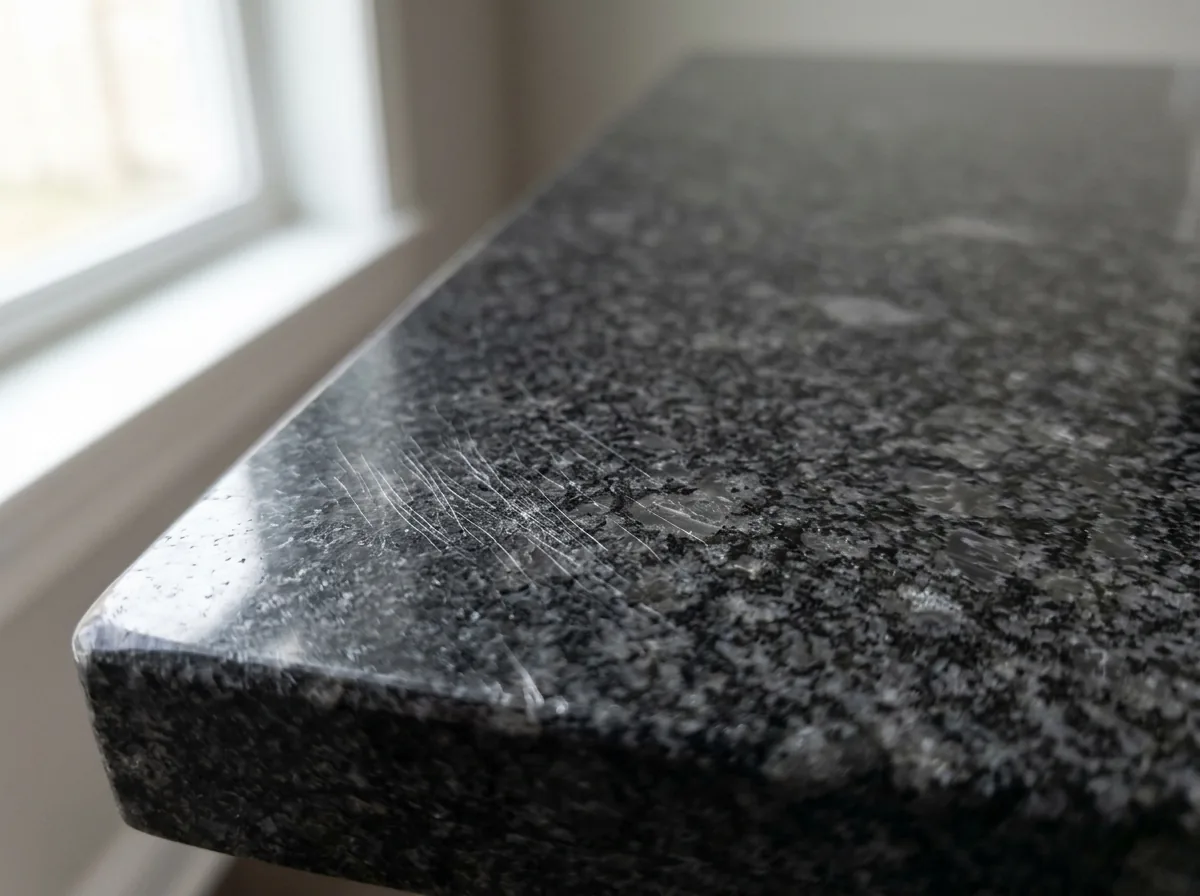
You ran a hand across the counter and felt a line. Before you buy a repair kit, check one thing: a lot of what looks like a scratch is metal left on the stone, not stone taken off. That one takes a minute to fix. A real scratch is a different conversation, and the honest answer changes completely depending on what your countertop is made of.
First, is it a scratch or a metal mark?
Granite, quartzite and quartz are harder than most of what sits on them. When an aluminum pan, a can, a stand mixer foot or a pot lid slides across the surface, the stone shaves a thin smear of metal off the object and that metal stays behind. You get a grey line that looks exactly like a scratch and is the opposite of one: material added, not removed.
Two checks tell them apart.
Your fingernail. Drag a nail slowly across the line, at a right angle to it. If the nail glides over and never catches, you are almost certainly looking at a deposit. If it drops into something and catches on one side, stone is missing.
A flashlight held almost flat. Raking light across the surface shows depth. A metal mark sits on top of the polish and the reflection runs straight through it. A scratch breaks the reflection.
Metal marks come off with a mild abrasive household cleaner and a non-scratch pad, with a little patience. No tools, no appointment. If that is what you have, you are done.
If the nail catches, keep reading. Call 206-653-4479 if you would rather just have someone look at a photo and tell you.
How each material answers the same sandpaper
This is the part most advice online gets wrong. "Can you buff out a scratch" has seven different answers, and the material you have decides which one applies to you.
| Material | How easily it scratches | Can it be polished out | Who should do it |
|---|---|---|---|
| Granite | Hard. A kitchen knife dulls before it marks the stone | Usually, on a polished finish | A stone pro, with diamond pads and water |
| Quartzite | Among the hardest surfaces in a kitchen | Usually | A stone pro |
| Quartz (engineered) | Easier than the name suggests, because of the resin | Partly, and the result can differ in sheen | A pro, with the limits explained first |
| Marble | Soft. A dropped lid or a sliding bowl can mark it | Yes, and it is routine work | A stone pro |
| Soapstone | The softest surface in the kitchen | Yes | You, at the kitchen counter |
| Porcelain or sintered | Very resistant, but unforgiving when it does happen | Not really | Nobody. Prevention is the whole plan |
| Stainless steel | Constantly, and that is normal for the material | Blended, not removed | You or a pro, always along the grain |
Two things in that table surprise people. Soapstone is the softest and also the easiest to fix, because the repair is the same thing you already do to maintain it. And quartz, which gets sold on being tough, is the one material where a scratch can be permanent in a way granite never is.
What you can safely do yourself
Three jobs are genuinely yours.
Metal marks, on any hard surface. Mild abrasive cleaner, non-scratch pad, rinse. Covered above.
Soapstone. Work a fine sandpaper over the scratch and a good margin around it, moving to a finer grit, then wipe on mineral oil. The stone darkens back and the repair disappears into the surface. Soapstone is the one countertop where the maintenance and the repair are the same act.
Stainless. A fine scouring pad worked only in the direction of the grain, never across it, blends a scratch into the brushed finish. Across the grain you make it permanent.
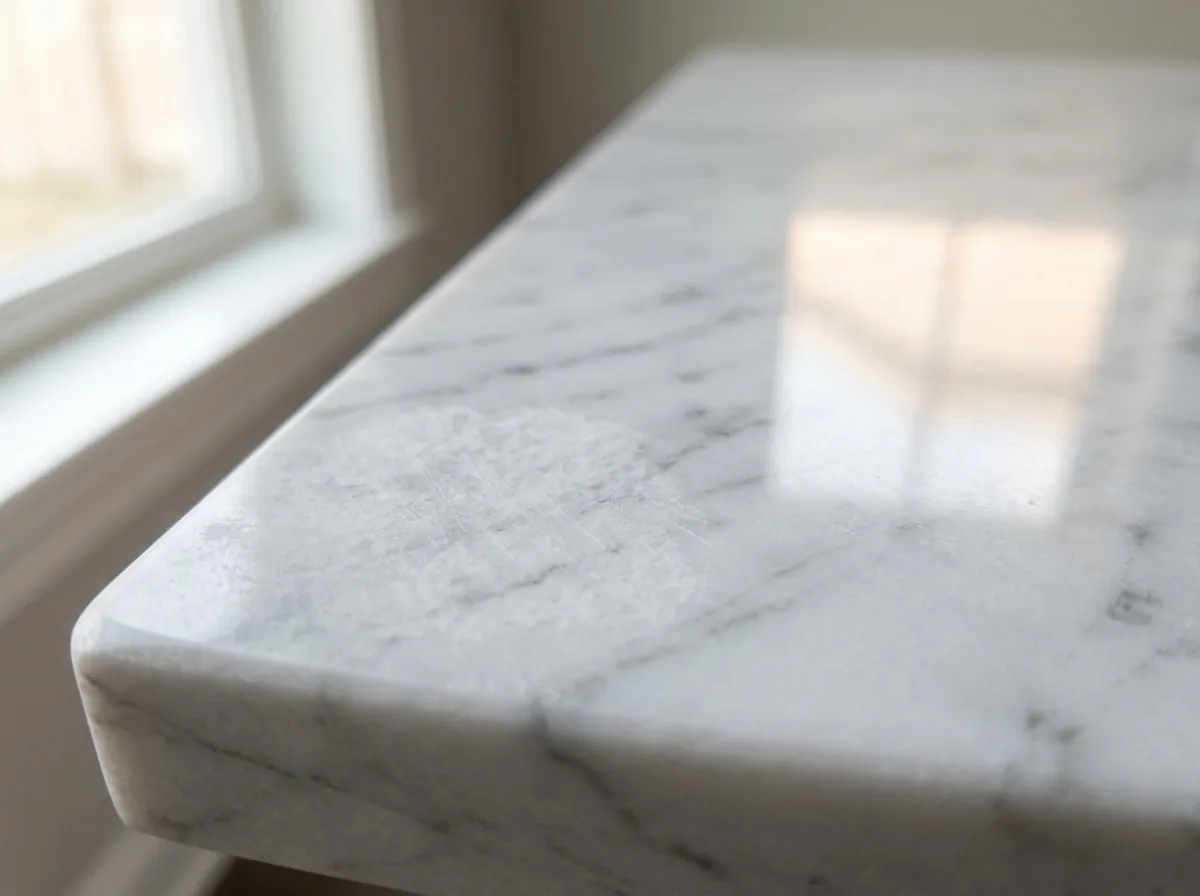
Now the part that costs people money. Do not take sandpaper to polished granite, quartzite, quartz or marble. You will almost certainly remove the scratch and leave a dull patch where the polish used to be, and a dull patch catches the eye from across the room in a way the scratch never did. Do not use acidic cleaners on marble either: you will trade a scratch for an etch, which is a different kind of damage.
What a professional repair actually involves
The hard part is not the sanding. It is the blending.
A stone technician works through a sequence of diamond pads, coarse to very fine, with water, and treats an area much larger than the scratch. The polish has to be carried out to a natural stopping point so the sheen matches when the light hits it. That is why a two inch scratch is not a two inch repair, and why doing it at home with a kit so often ends with a visible halo.
On a polished granite or quartzite top, this usually works well and the result is hard to find afterward. On marble it is routine, and marble is refinished so often that there is a whole trade built on it. We will tell you which category yours is before anyone touches it.
If you want depth on your specific material, the service pages go further: granite countertop repair, quartzite countertop repair and quartz countertop repair. The main repair page covers the rest.
Quartz is the one that does not simply buff out
Engineered quartz is roughly nine parts ground stone to one part resin binder. The stone grains are very hard. The resin holding them is not, and it is also the part that carries the shine.
That changes everything about the repair. Polishing creates heat, and heat is what resin reacts to: it can burnish, cloud or shift color slightly. So a careful technician goes lighter and slower on quartz than on granite, and accepts a smaller result. Sometimes the honest outcome is that a mark is much less visible and still findable if you know where to look.
We say that out loud before starting, because the alternative is you paying for work and then discovering the limit yourself. If a scratch in quartz is deep enough to catch a nail firmly, ask about the limits before you ask about the price.
Not sure the repair is even the right conversation? If you are weighing a fix against a new top, the budget planner gives you a replacement range in about two minutes, so you have both numbers in front of you.
What moves the cost of a scratch repair
We do not quote scratch work from a price list, because the same scratch is a different job on two different counters. What actually moves it:
- The material. Marble and granite respond predictably. Quartz takes longer for a smaller result.
- The finish. A polished surface has to be brought back to a mirror. Honed and leathered finishes are more forgiving and usually faster.
- How much has to be blended. One scratch in the middle of a wide island means refinishing a large area so the sheen is even.
- Where it sits. A scratch running off an edge, into a seam or beside a cutout takes more care than one out in open field.
- How many there are. Several scratches in one zone are often cheaper together than one at a time.
Our repair pricing comes from looking at photos, not from a calculator. That is deliberate: a number given without seeing the stone is a number that changes later.
Stopping the next one
The thing that scratches your counter is usually not a knife. It is grit. Sand and street dirt tracked into a kitchen are harder than most countertop surfaces, and they get dragged around under the things you slide: a mixer, a ceramic bowl, a cast iron pan, a bag of groceries.
So: lift instead of sliding, keep felt pads under anything heavy that lives on the counter, wipe the surface before you work on it rather than after, and use a cutting board, which protects your knives as much as your stone. On marble, add one more: deal with spills quickly, because the etch will bother you long before any scratch does. There is more on that in our guide to stains and etch marks.
Frequently asked questions
Can a scratch be removed from a granite countertop?
In most cases yes. Granite is hard enough that true scratches are uncommon, and when one does happen a stone technician can usually polish it out with diamond pads and water. The work extends well beyond the scratch itself so the sheen stays even across the surface. First check whether you have a scratch at all: drag a fingernail across the line, and if it glides without catching you are probably looking at a metal mark that wipes off with a mild abrasive cleaner.
Why does my quartz countertop have scratches if quartz is scratch resistant?
Engineered quartz is about nine parts ground stone to one part resin. The stone grains are very hard, but the resin between them is softer, and the resin is what carries the shine. Grit dragged under a heavy object cuts the resin, not the quartz. It also means the repair behaves differently: polishing generates heat, resin reacts to heat, and a technician has to work lighter and slower, sometimes for a partial result. We explain the limit before starting rather than after.
Will sanding a scratch leave a dull spot?
On a polished surface, almost certainly, if the work stops at the scratch. Removing the scratch is easy; restoring the polish evenly around it is the skilled part. That is why a professional refinishes a whole zone instead of a small patch, and why home repair kits so often leave a halo that is more noticeable than the original mark. Soapstone is the exception: it is meant to be sanded and oiled, and the repair blends in on its own.
What are the grey lines on my countertop that will not wipe off?
Usually metal, not damage. Aluminum pans, cans, pot lids and appliance feet are softer than granite, quartzite and quartz, so the stone scrapes metal off them and it stays on the surface as a grey streak. A mild abrasive cleaner and a non-scratch pad take it off with some patience. If a fingernail catches on the line, it is a scratch instead and needs a different approach.
Can I repair a scratched soapstone countertop myself?
Yes, and this is the one countertop where that is the normal answer. Sand the scratch and a generous area around it with fine sandpaper, step up to a finer grit, then wipe on mineral oil. The stone darkens back to its usual tone and the repair disappears. Soapstone is soft enough to mark easily and forgiving enough that fixing it is part of ordinary upkeep rather than a service call.
Does a scratched countertop need to be replaced?
Very rarely. Most scratches are either a metal mark that cleans off or a surface issue a technician can refinish. Replacement enters the conversation for porcelain and sintered surfaces, where the finished layer cannot be re polished, or when scratching comes with other damage such as a crack through a cutout. If you are weighing repair against replacement, send photos first and get the replacement range from the budget planner, then compare the two with real numbers.
Send two photos and we will tell you what you have
You do not need to book anything to get an answer. Take one photo straight down on the mark in normal light, and one from the side with a flashlight held almost flat across the surface, which is what makes depth show up. Tell us the material if you know it. We will tell you honestly whether it is a metal mark you can clean off yourself in ten minutes, a scratch worth refinishing, or something we would leave alone.
Top Granite is a family business in Lynnwood, rated 5.0 on Google across 49 reviews, and we measure and install with our own crew. Call or text 206-653-4479, use the contact page, or if the real question is a new countertop, start with the budget planner.
What could your
countertops cost?
Answer a few questions about your space and material and get an estimated range in about two minutes. Your formal quote follows a laser template and a review of the scope.
Your ideas in. A clearer next step out.
Rather talk it through? 206-653-4479 ↗︎What would you like to change?
Which material are you leaning toward?
Build my countertop estimateChoose your details and see your estimated range.
Related reading.
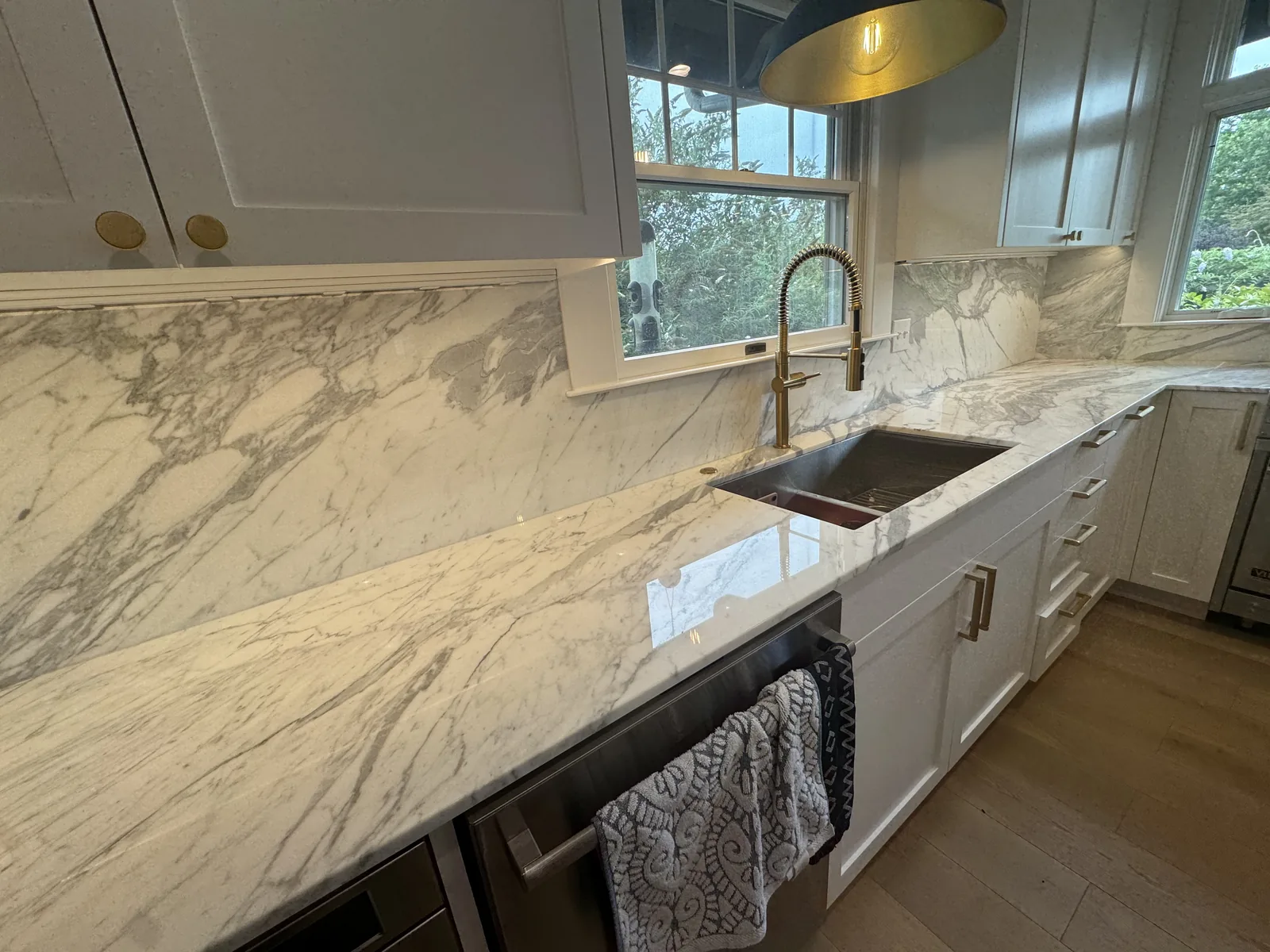
Repair or replace your countertop? 7 damages compared
A chip at the sink, a crack over the dishwasher, a seam that opened. See which countertop damage is worth repairing, when replacement is the better buy, and what moves the cost.
Read article ↗︎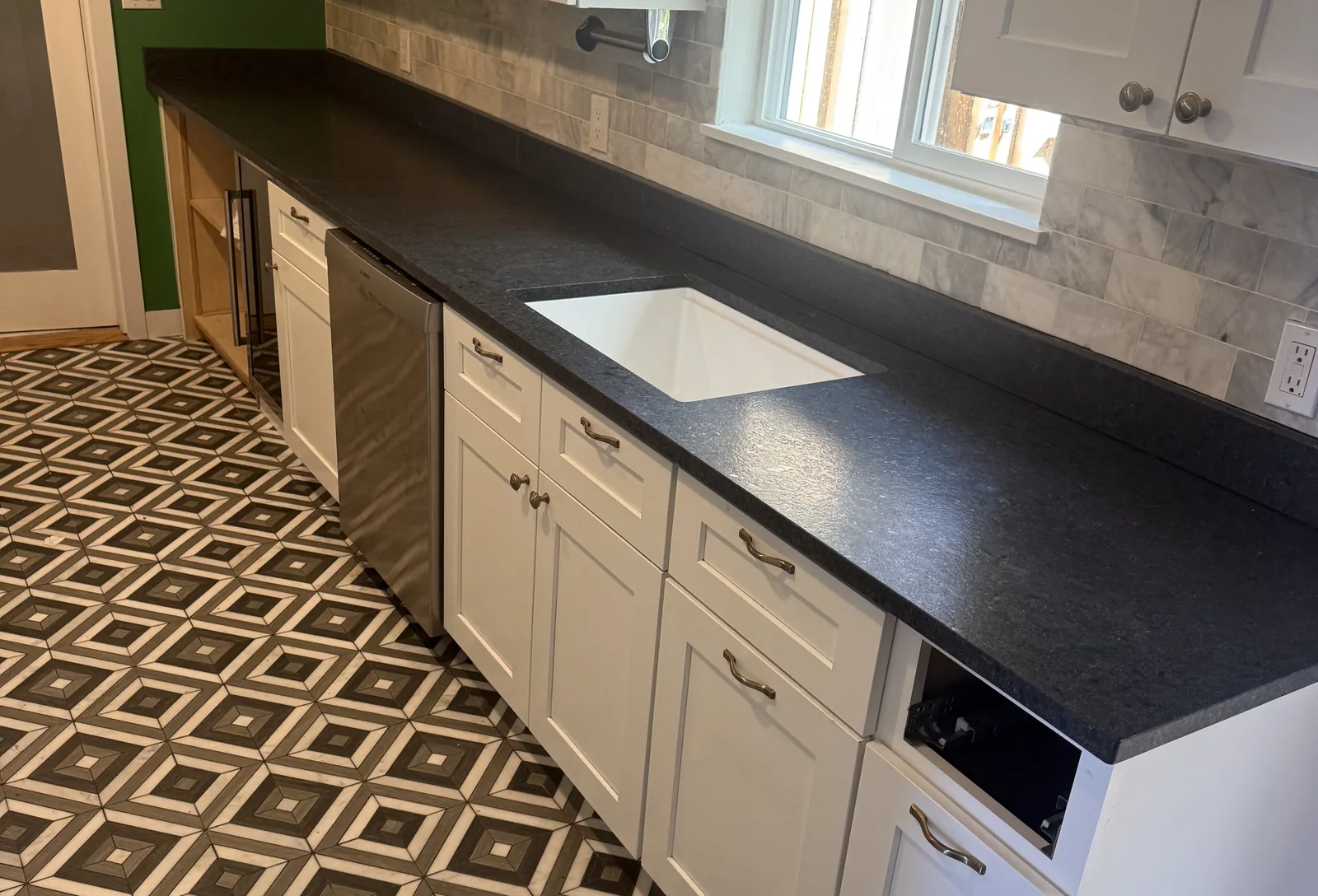
Why countertops crack over the dishwasher and at cutouts
A crack in front of the dishwasher, or out of a cutout corner, is almost never a bad slab. It is an unsupported span, heat from the appliance and hardware pressing on the stone. How to read where it started, what a repair can honestly do, and what prevents the next one.
Read article ↗︎
Your undermount sink came loose: why it happens and what fixes it
A sink that has dropped, tilted or pulled away from the stone is a mounting failure, not a stone failure. What to do in the first ten minutes, the seven things that cause it, and what a proper re-set actually involves.
Read article ↗︎Bring your ideas.
We’ll help with the next step.
Choose the next step that feels right for you.