

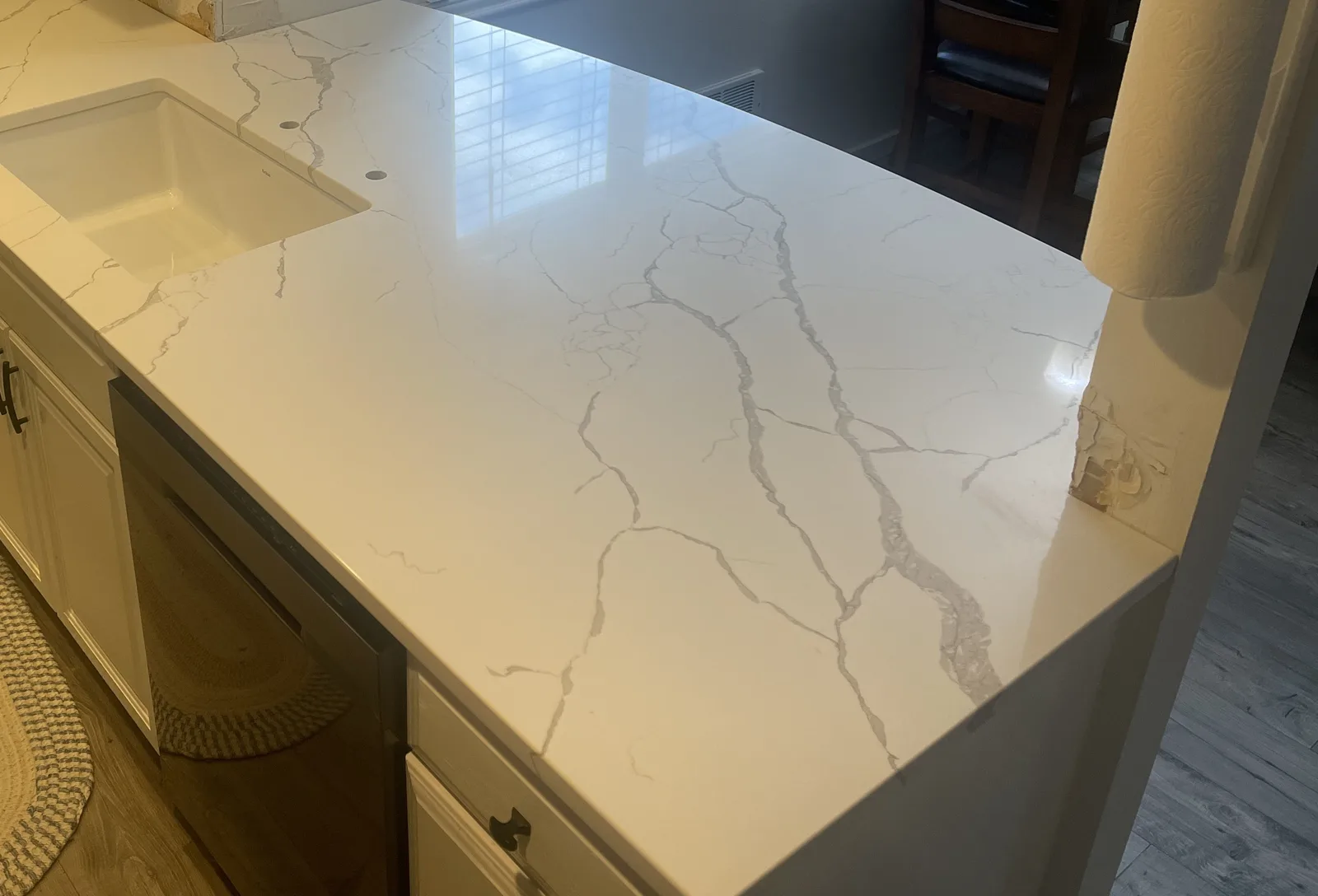
A chipped edge is the countertop damage we get called about most, and the one people look at hardest, because it sits at hand height and catches the light every time you walk past. Nearly all of them can be filled where they are. What decides whether the repair still looks right a year from now is not the filler. It is whether anyone dealt with the reason the chip happened.
Edge chips happen in the same four places
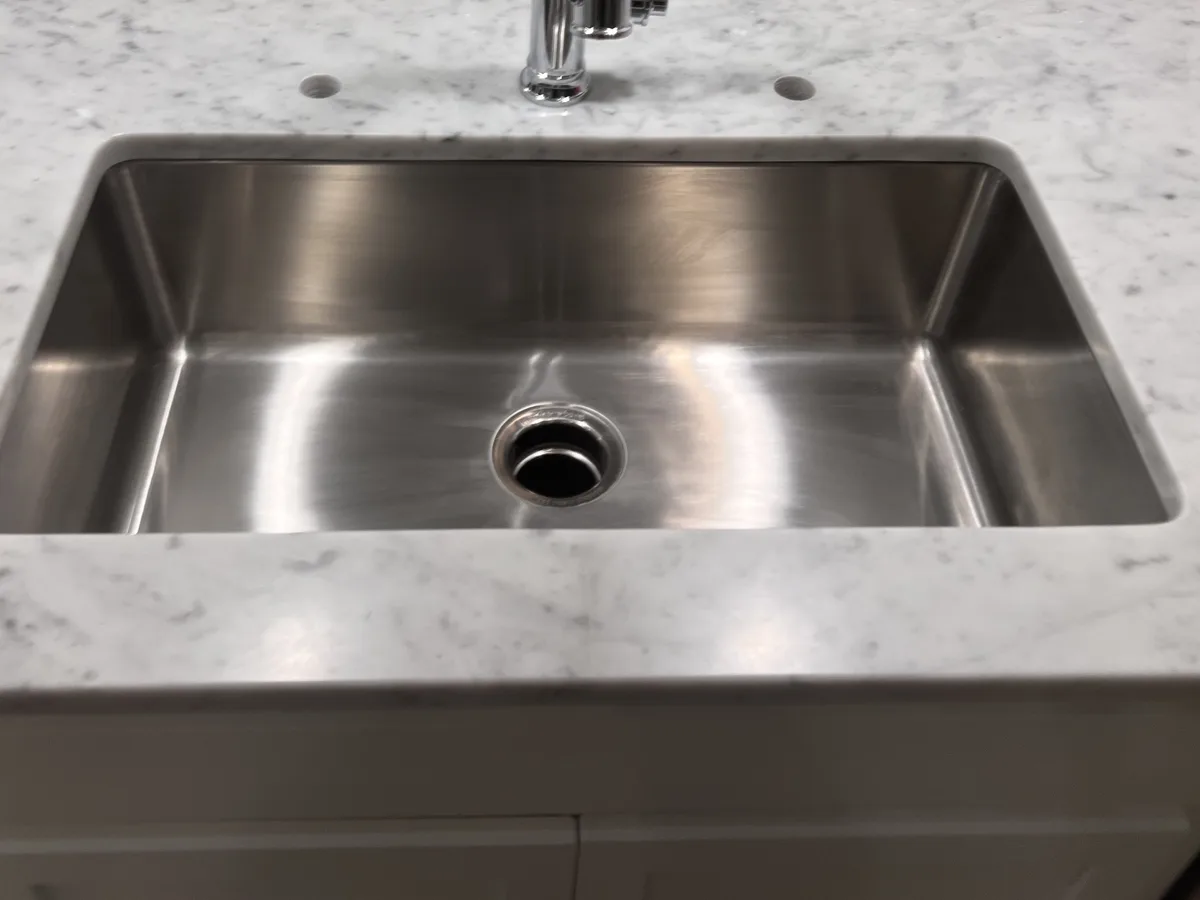
The rail in front of the sink. With an undermount sink there is often only three or four inches of stone between the bowl and the front edge, and the inside of that opening is a cut face rather than a shaped profile. A pan set down on the rim or a dropped sprayer head lands on the thinnest material in the countertop.
The outside corner. A peninsula or island corner standing in a walkway is the one place on a countertop that things run into rather than land on. It takes hits from the side, which is the direction stone likes least.
The ends of a seam. Where two pieces meet at the front edge there are two edges side by side instead of one continuous run, and a knock there can take a flake off both at once.
The lip above the dishwasher. Plates come up out of a loaded rack at an angle and tap the underside of the front edge. Those chips start from below, which is why people find them weeks later, by feel.
Why the edge gives out before the rest does
A countertop is enormously strong as a continuous, supported field of stone. Three things make the edge the exception.
The first is thickness: at the edge you are down to the depth of the slab and nothing else, with air on two sides. The second is the shape of the edge. A square edge concentrates a blow along one sharp line of material, while an eased, bullnose or ogee spreads it over a curve. Our page on edge profiles covers how each one wears, not only how it looks.
The third is what hits it. A heavy pan set down flat rarely chips anything, because the load spreads. A small hard object with a point wins every time: the corner of a cast iron lid, the rim of a stoneware mug, a can dropped from the cabinet above. All of the energy arrives on an area the size of a pencil tip.
If you are looking at one right now, you do not have to guess. Send two photos through our contact page or call 206-653-4479, and we will tell you what it is before anyone drives out, at no charge.
What a chip repair actually involves
A proper edge repair is a small, patient job done in place. It is not a dab of filler, and it is not a mystery either.
Clean it and dry it. The inside of a fresh chip collects grease and soap within days, and nothing bonds to that. Natural stone also needs time to dry fully, which quartz does not.
Key the edges. The feathered rim around a chip is already fractured and will break away later if it is left, so it gets cut back to sound material.
Match the color on the stone, in daylight. Pigments are mixed and tested on the countertop itself, under the light the kitchen actually has. This is the slow part, and it decides how the repair reads. A busy granite is easier to disappear into than a plain solid white.
Build it proud, then take it back. The fill goes in slightly above the surface, cures, then gets shaped down to the exact line of the edge profile. Getting that curve right is most of the work, because the eye catches a wrong profile faster than a wrong color.
What we will not tell you is that it disappears. On busy natural stone a good fill is genuinely hard to find. On a plain white quartz, in daylight, you will see it if you look. The goal is an edge that is sound, sealed, smooth to the hand and far less noticeable than the chip.
When the fill holds, and when the chip comes back
A fill fails for one of two reasons: there was not enough stone left to hold anything, or whatever caused the chip is still there. Treat the table as a starting point, because two chips that look the same in a photo can be different jobs depending on what sits underneath.
| The situation | How the fill usually does | What decides it |
|---|---|---|
| Small chip on the top, back from the edge | Holds well, long term | The easiest repair there is |
| Chip on the edge profile, under about an inch | Holds well | Whether the fractured rim was cut back first |
| Chip at the sink rail | Holds, once the sink is checked | A sagging sink keeps working that rail |
| Chip on a corner that still gets traffic | Comes back, unless something changes | Whether the corner can be eased while we are there |
| Chip where you kept the broken piece | Best result available | How clean the break is |
| Chip at the end of a seam | Holds, if the seam is dealt with first | Whether the cabinets under it are still level |
| Chip on a honed or leathered finish | Holds, but the sheen is the hard part | How wide the repaired area ends up |
The fourth row is worth reading twice. A corner that has been hit once will be hit again, and filling it without changing the geometry just resets the clock.
The first hour matters more than any repair kit
Find the piece and keep it. A chip bonded back with its own stone beats the best color match there is, because the pattern and the finish are already right. Put it in a cup, and do not wash it.
Tape over it. A strip of painter's tape keeps the sharp edge from catching a sleeve and keeps the next knock from making it bigger.
Keep it dry. Water standing in an open chip in granite or quartzite will darken the stone around it, and that mark takes longer to deal with than the chip did.
Leave the superglue in the drawer. Household glues and store epoxies soak into the stone and cure a color that cannot be changed, so they have to be dug back out first. The home remedies worth trying are the ones for stains and etch marks, not for chips.
How each material takes a fill
Granite takes a repair well, because the pattern gives a fill somewhere to hide: see granite countertop repair. Quartz bonds beautifully but gives a repair nowhere to disappear on solid whites: see quartz countertop repair. Quartzite chips less often and breaks cleaner when it does: see quartzite countertop repair. Marble chips more easily than any of them and dulls as well, so a marble edge usually needs refinishing along with the fill.
What moves the cost of an edge repair
We do not publish a price for repair work, because a photo of a chip does not tell you what the job is. Four things move it: how much stone is missing, since past a certain size filling stops being the right answer; where it is, because a chip behind a faucet or under a cooktop lip means something comes out first; the color and finish, since solid whites and honed surfaces take far longer to match; and what else we find. A chip at the sink rail with a sink that has started to drop is two pieces of work, and fixing only the chip wastes your money: see what to do when an undermount sink comes loose.
If the answer turns out to be replacement, our countertop estimate planner gives a realistic range for new countertops in about two minutes. For a repair, photos first. Our countertop repair page covers what a visit includes, and countertop repair in Lynnwood shows how a visit in our own city runs.
Frequently asked questions
Can a chipped countertop edge be repaired, or does it have to be replaced?
Nearly all edge chips are repairable in place, and the countertop stays where it is. The chip is cleaned, cut back to sound material, filled with a color matched resin, shaped to the edge profile and polished to match the finish around it. Replacement becomes the better answer when a long stretch of edge is gone, or when the piece has broken all the way through.
Will the repair be invisible?
No, and anyone who promises that is overselling. On a busy granite or a veined quartzite a good fill is very hard to find. On a plain white quartz, in daylight, you will see where it was if you look for it. What you get is an edge that is sound, smooth to the hand, sealed against water and far less noticeable than an open chip.
I found the broken piece. Does that actually help?
It helps more than anything else you can do. A chip bonded back with its own stone keeps the right color, pattern and surface finish, which no pigment match fully reproduces. Put it somewhere safe, do not wash it, and have it out when we arrive. Even a piece broken into two or three fragments is usually worth keeping.
Can I fix a countertop chip myself with an epoxy kit?
On a small chip in busy natural stone it sometimes looks fine. The risk is that a wrong attempt makes the real repair harder, because household glues and store epoxies soak into the stone and cure a color that cannot be changed. If the chip is on a plain quartz, at the sink, or bigger than a pea, send a photo first.
Why did the same corner chip twice?
Because the repair fixed the damage and not the cause. A corner standing in a walkway will keep being hit. The fix is to change the geometry rather than only the appearance, usually by easing that corner to a small radius so a knock glances off instead of taking a flake.
Does a chip at the sink mean my sink is loose?
Not always, but it is worth checking before anyone fills anything. An undermount sink that has started to drop puts a steady pull on the narrow rail of stone in front of it, and a chip there can be the first sign. Press gently up on the bottom of the sink from inside the cabinet and watch the rim for movement.
Send a photo and we will tell you what it is
Two photographs settle a chip in minutes: one straight down on the damage, one from the side with the light low across the surface so the depth shows. If you kept the broken piece, photograph that beside it. Send them through our contact page or call 206-653-4479. Top Granite is a family business based in Lynnwood, serving greater Seattle and the Eastside, Monday to Friday 8am to 6pm and Saturday 8am to noon.
What could your
countertops cost?
Answer a few questions about your space and material and get an estimated range in about two minutes. Your formal quote follows a laser template and a review of the scope.
Your ideas in. A clearer next step out.
Rather talk it through? 206-653-4479 ↗︎What would you like to change?
Which material are you leaning toward?
Build my countertop estimateChoose your details and see your estimated range.
Related reading.
Repair or replace your countertop? 7 damages compared
A chip at the sink, a crack over the dishwasher, a seam that opened. See which countertop damage is worth repairing, when replacement is the better buy, and what moves the cost.
Read article ↗︎
Countertop stains and etch marks: what comes out and what does not
A stain soaked in and can often be drawn back out at home. An etch mark ate the polish and has to be worked back by hand. How to tell them apart, the water test for your sealer, and what needs a repair visit.
Read article ↗︎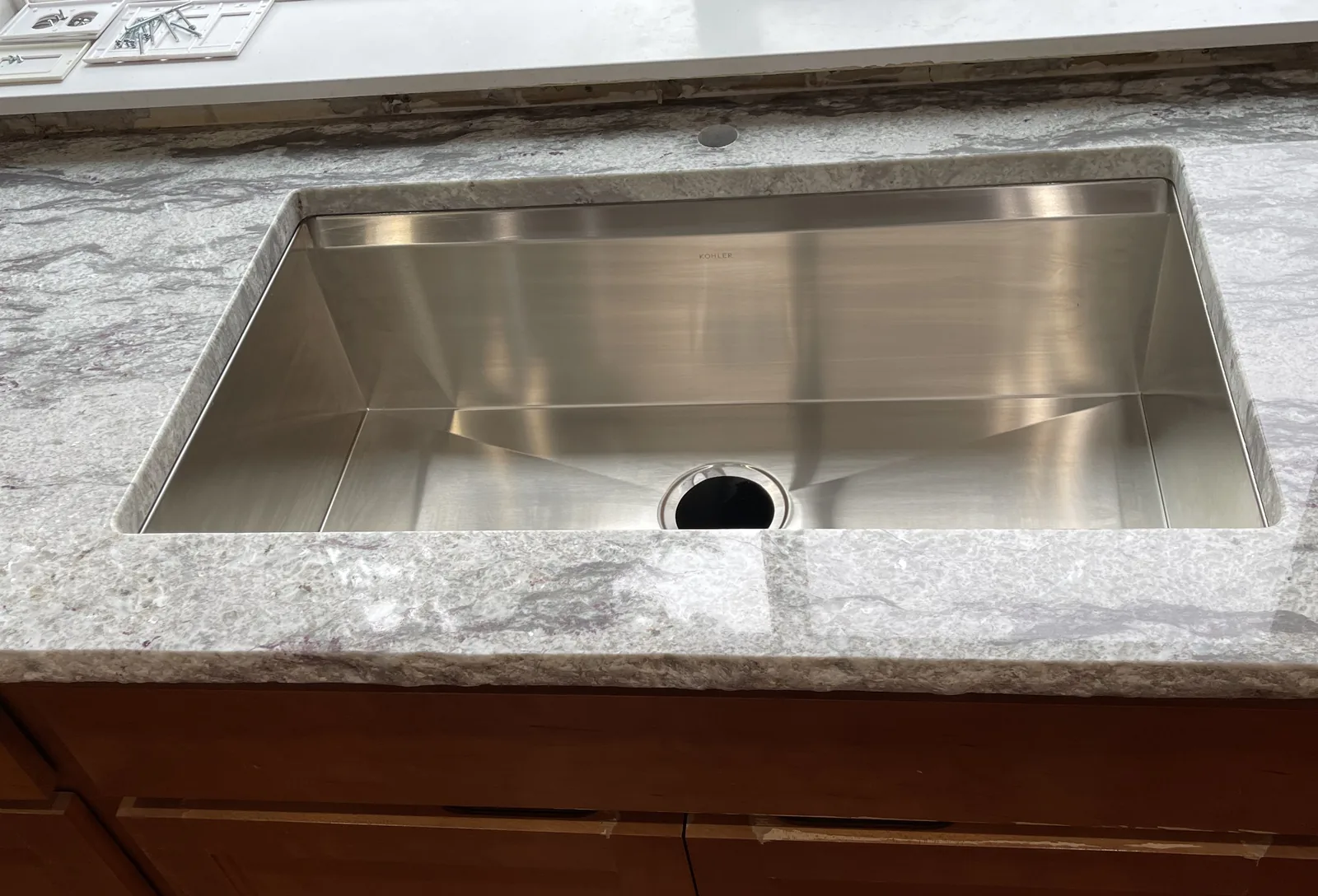
Your undermount sink came loose: why it happens and what fixes it
A sink that has dropped, tilted or pulled away from the stone is a mounting failure, not a stone failure. What to do in the first ten minutes, the seven things that cause it, and what a proper re-set actually involves.
Read article ↗︎Bring your ideas.
We’ll help with the next step.
Choose the next step that feels right for you.