

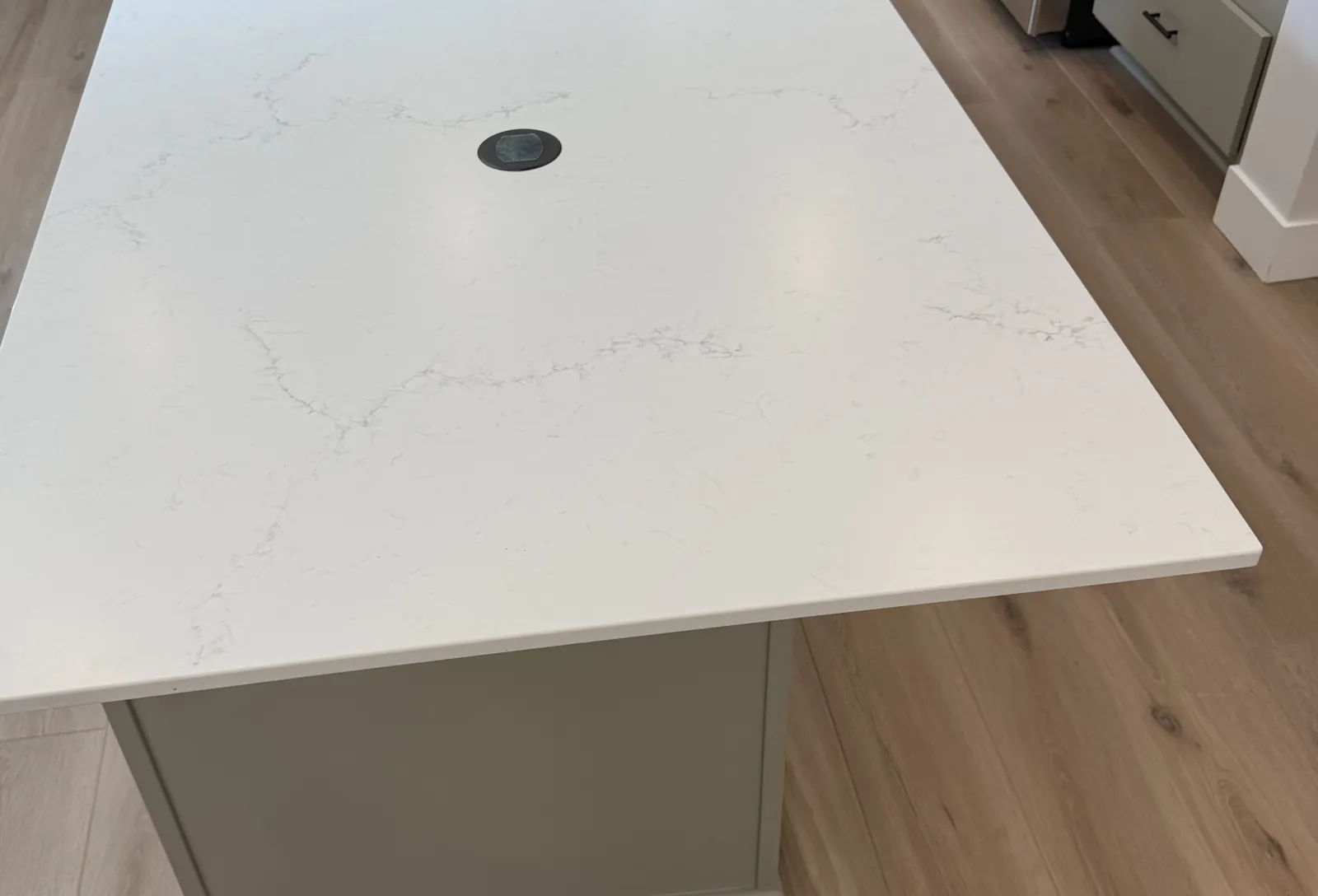
Press down on the end of your counter and it gives a little. Or the edge by the stools sits lower than it used to. Or a run has eased away from the wall and left a line you can see. Stone does not bend. If your countertop moves, something under it moved first, and that is usually fixable without buying a new top. Here is what actually holds a countertop up, and five checks that tell you which part let go.
Stone does not flex, so something under it moved
Granite, quartzite and quartz are rigid. They do not sag slowly the way a loaded wood shelf does. They keep their shape until whatever is beneath them stops keeping its own, and then they follow it down. Pushed far enough, they crack instead of bending.
That one fact changes the whole conversation. A top that dips in front of the dishwasher is not a bad slab. It is a span with nothing under it. A counter that has pulled off the wall is usually a cabinet that shifted or a fastener that let go. In almost every one of these the stone itself is fine, and the work happens underneath it.
It also means waiting is not free. A top that is already moving is loading itself in a way it was never meant to, and the next thing that happens is a crack at the weakest point, which is a harder and more expensive problem than the one you have now. More on that in why countertops crack over the dishwasher and at cutouts.
What is actually holding your countertop up
Four things do the work, and most kitchens use more than one.
The cabinet boxes. Most of the weight sits straight down on the cabinet tops, through shims that bring everything dead level. When the boxes are level and solid, the stone has an easy life. When one box settles a few millimeters, every problem in this article starts there.
A plywood deck. On many older installs, and under thinner stone, a sheet of plywood bridges the cabinet tops and the stone beds onto that. It spreads load nicely. It also swells if it ever gets wet, which lifts the stone off level.
Steel brackets. Flat steel plates screwed down into the cabinet top, reaching out under an overhang. They sit inside the thickness of the build-up, so from a stool you see nothing at all. This is the usual answer for a seating overhang.
Corbels. The visible kind, wood or metal, carrying a long overhang or a raised bar from below. They are a design choice as much as a structural one.
There is a fifth thing people assume is support and is not: silicone. Silicone seals a joint and keeps water out. It carries no weight. If a counter is standing on adhesive, it is standing on borrowed time.
If you are not sure which of these your kitchen has, you do not have to guess. Send us a photo taken from inside the cabinet, looking up, and we will tell you what you are looking at, free, before anyone talks about work. Call or text 206-653-4479, or use the contact page. How a top gets set and leveled in the first place is on our countertop installation page.
Five checks you can run in ten minutes
You need a flashlight and, if you have one, a level. Nothing here can damage anything.
Press down on the overhang
Put a flat hand near the outer edge and lean on it, firmly, the way someone leans while talking to you. A properly carried overhang does not move at all. If you feel any give, or hear a small tick, write down roughly where it was.
Open the cabinet and look up
Shine the light along the underside. You are looking for three things: steel plates or corbels (support that exists), a plywood sheet that is dark, stained or puffy at the edges (support that has failed), and daylight between the stone and the cabinet top where the two should be touching.
Level the top, then level the cabinet
Run a level along the stone, then along the cabinet top beside it. If both read the same way, the cabinets moved and the stone just followed. If the stone is off and the cabinet is true, the problem is in the shims or the deck in between. That distinction decides most of the repair.
Check the line where it meets the wall
A gap that has opened at the back, or caulk that has torn along the top, means the run has dropped or rotated away from the wall. Look at whether the gap is even or wider at one end. Wider at one end points straight at the cabinet that moved.
Open the dishwasher and watch the counter
Pull the door down with the rack loaded and look at the stone above it. Any movement there is a span carrying an appliance that is tugging on it. That is the single most common place a top starts to go, and it is also the place that cracks.
What you felt, and what it usually means
Treat this as a starting point, not a diagnosis. Two counters that behave the same can need very different work once someone has a hand underneath.
| What you found | Usual cause | What it usually needs |
|---|---|---|
| Flex only at a seating overhang | The reach past the cabinet is longer than the stone can carry alone | Steel let into the build-up, or corbels |
| Flex over the dishwasher opening | A span with no rail or bracket across it | A support rail added across the opening |
| Whole run low at one end | A cabinet box that settled or was never shimmed true | Relevel the cabinet, then reset the stone |
| Gap opened along the wall | The run has rotated or dropped away from the back | Refix at the wall after the cause is corrected |
| Soft, dark or swollen plywood underneath | Water tracked in, usually from a sink or a seam | Stop the water, replace the deck, reset the top |
| Movement plus a hairline at a cutout corner | The span already loaded the stone past its limit | Support first, then the crack as a separate repair |
| Sink dropping, counter steady | Mounting failure at the sink, not a support problem | See the sink article below |
That last row catches a lot of people. If what is actually sinking is the bowl and not the stone, you want your undermount sink came loose instead. And if the line you are worried about is a joint rather than a dip, read a countertop seam that opened.
How far stone can reach before it needs help
There is a working guideline the trade uses, and it is worth knowing as a reference rather than a rule for your specific top. For 3cm stone, roughly ten inches past the cabinet face is the usual limit before support goes in. For 2cm, roughly six. Past that, steel or corbels carry the rest.
Those are starting numbers, not promises. The real answer depends on the material, the slab, how much of it is cut away for a sink or a cooktop nearby, and what the overhang is used for. A ledge nobody touches and a bar where two people sit are not the same problem. We settle it on site with a laser template, which is also where we catch cabinets that are out of level before anything is cut. That process is on our laser templating page.
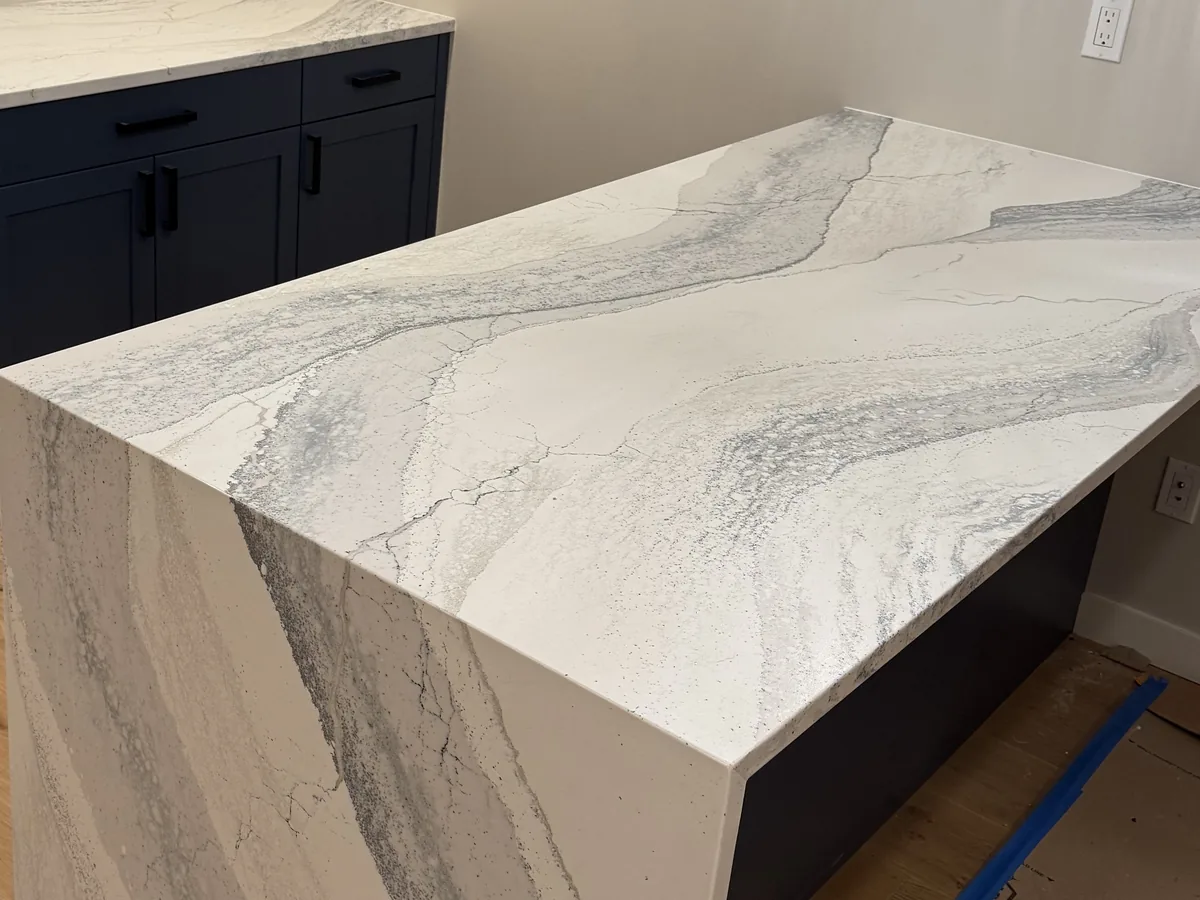
One thing that catches people out: a mitred waterfall edge, where the stone folds down the side, adds no support at all. Neither does a thicker-looking built-up edge. Both are appearance. The edge profiles page covers what each one actually is. Material matters a little too, and you can read how each behaves on the quartz and granite pages.
What the fix actually involves
Cause first, stone second, every time. Adding a bracket under a counter that is low because the cabinet settled just locks the error in place.
In practice that means the top usually comes up. Done properly this is a careful lift with suction cups, not a demolition, and the same piece goes back down. With the stone off, the cabinets get releveled, a failed deck comes out and a new one goes in, steel or corbels get set where the reach needs them, and the top is bedded back and resealed at the wall.
Most of these are a single visit. What stretches one is never the support itself. It is whatever has to be sorted out underneath first: a sink that has to come off, a swollen deck that has to dry or be replaced, or a plumbing leak that caused the whole thing and is still running.
And the honest limit. If the stone has already cracked at the span, fixing the support stops it getting worse but does not undo the crack. That is a second, separate repair, and what it can and cannot do is set out on the countertop repair page.
What moves the cost
We do not publish a number for this, and nobody should quote you one from a description. Looking at it costs you nothing, and plenty of these turn out to be a shim and an hour.
What moves the number is access and what has to come apart, not the length of the counter. A bracket added through an open cabinet is quick. The same bracket under a run with a sink, a dishwasher and a swollen deck in the way is a different day. Water damage below is the one that changes the picture most, because then there is a cabinet to deal with as well as a counter. If it turns out the top is past saving, countertop replacement covers that route instead.
We cover Snohomish and King County, including Lynnwood, Seattle and Kent. If you are weighing a repair against a new top, the budget planner gives you a range for your own kitchen in about two minutes, with nobody calling you first.
Frequently asked questions
Is it normal for a countertop overhang to flex a little?
No. A correctly supported overhang does not move under a leaning adult, and you should not be able to feel it give. Any flex means the reach past the cabinet is longer than that stone can carry on its own, or that the support which was meant to be there has worked loose. It is not dangerous today, but it is the condition that cracks later, so it is worth having looked at rather than lived with.
How much countertop overhang can you have without support?
As a general reference the trade works to roughly ten inches past the cabinet for 3cm stone and roughly six for 2cm, with steel or corbels beyond that. Treat those as starting numbers rather than a rule for your top. The real limit depends on the material, the slab itself, how much of it is cut away nearby for a sink or cooktop, and whether people sit at it. That is one of the things a laser template settles before anything is cut.
Can a sagging countertop be fixed without replacing it?
Usually yes, and the same stone goes back. The top is lifted with suction cups, the real cause underneath is corrected, whether that is releveling a cabinet, replacing a water damaged deck or adding steel across a span, and the piece is bedded back down and resealed. Replacement only enters the conversation when the stone has already cracked through in more than one place, or when water has taken out the cabinets as well.
Do I need corbels, or can the brackets be hidden?
For most seating overhangs, hidden steel does the job and you see nothing from a stool. Flat plates are screwed into the cabinet top and reach out inside the thickness of the build-up. Corbels become the answer when the reach is long, when the load is heavier than normal seating, or when you want them for the look. One is not stronger than the other by default; what matters is that whichever you use is sized for the reach and fixed into solid cabinet, not into a thin panel.
My countertop pulled away from the wall. Is that the counter or the cabinets?
Almost always the cabinets. The stone has not shrunk, so a gap that opened at the back means the run dropped or rotated. Look at the gap along its length. An even gap usually means the whole run settled. A gap that is wider at one end points at the cabinet under that end. Recaulking it will hide the line for a while and will not stop the movement, so it is worth finding out which cabinet moved before sealing anything.
Can I put support under the countertop myself?
You can safely check what is there and take photographs, and that genuinely helps. Fitting support is a different matter, because the bracket has to be sized for the reach and fixed into something solid, and because anything that levers a stone top that is already moving can turn a flex into a crack. The part we would ask you not to do is force anything upward to close a gap. Photograph it, including the view from inside the cabinet, and we will tell you what it needs.
Send three photos and we will tell you what it needs
Three photographs settle most of these. One straight down the length of the counter with a low light across it, so any dip shows. One from inside the cabinet looking up at the underside. One of the gap at the wall, if there is one. Text or email them, say which way it moves when you press, and we will tell you honestly whether you are looking at a shim, a bracket or something bigger. That costs you nothing. Call or text 206-653-4479, use the contact page, or if this started as a remodel question rather than a repair, begin with the budget planner.
What could your
countertops cost?
Answer a few questions about your space and material and get an estimated range in about two minutes. Your formal quote follows a laser template and a review of the scope.
Your ideas in. A clearer next step out.
Rather talk it through? 206-653-4479 ↗︎What would you like to change?
Which material are you leaning toward?
Build my countertop estimateChoose your details and see your estimated range.
Related reading.
Repair or replace your countertop? 7 damages compared
A chip at the sink, a crack over the dishwasher, a seam that opened. See which countertop damage is worth repairing, when replacement is the better buy, and what moves the cost.
Read article ↗︎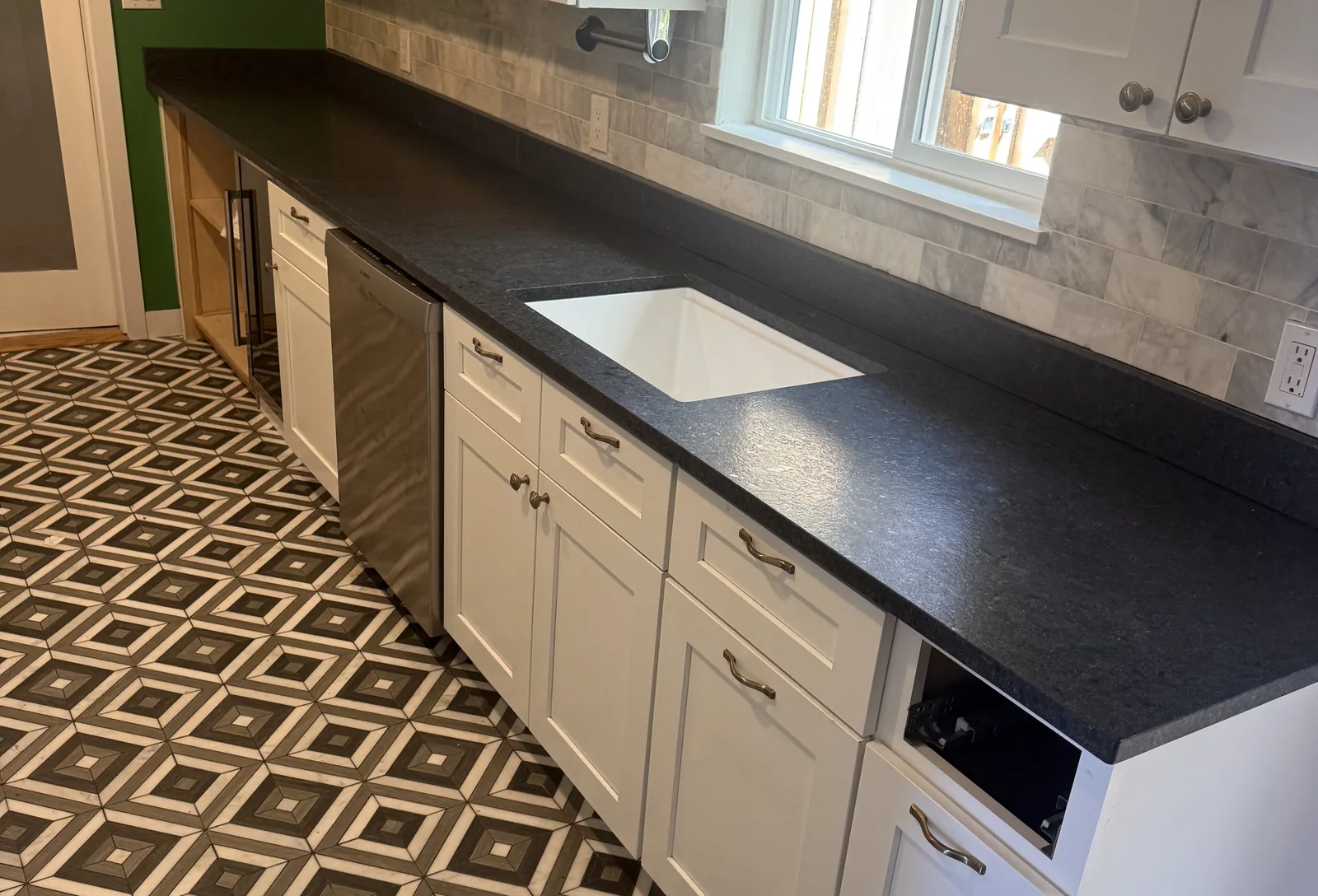
Why countertops crack over the dishwasher and at cutouts
A crack in front of the dishwasher, or out of a cutout corner, is almost never a bad slab. It is an unsupported span, heat from the appliance and hardware pressing on the stone. How to read where it started, what a repair can honestly do, and what prevents the next one.
Read article ↗︎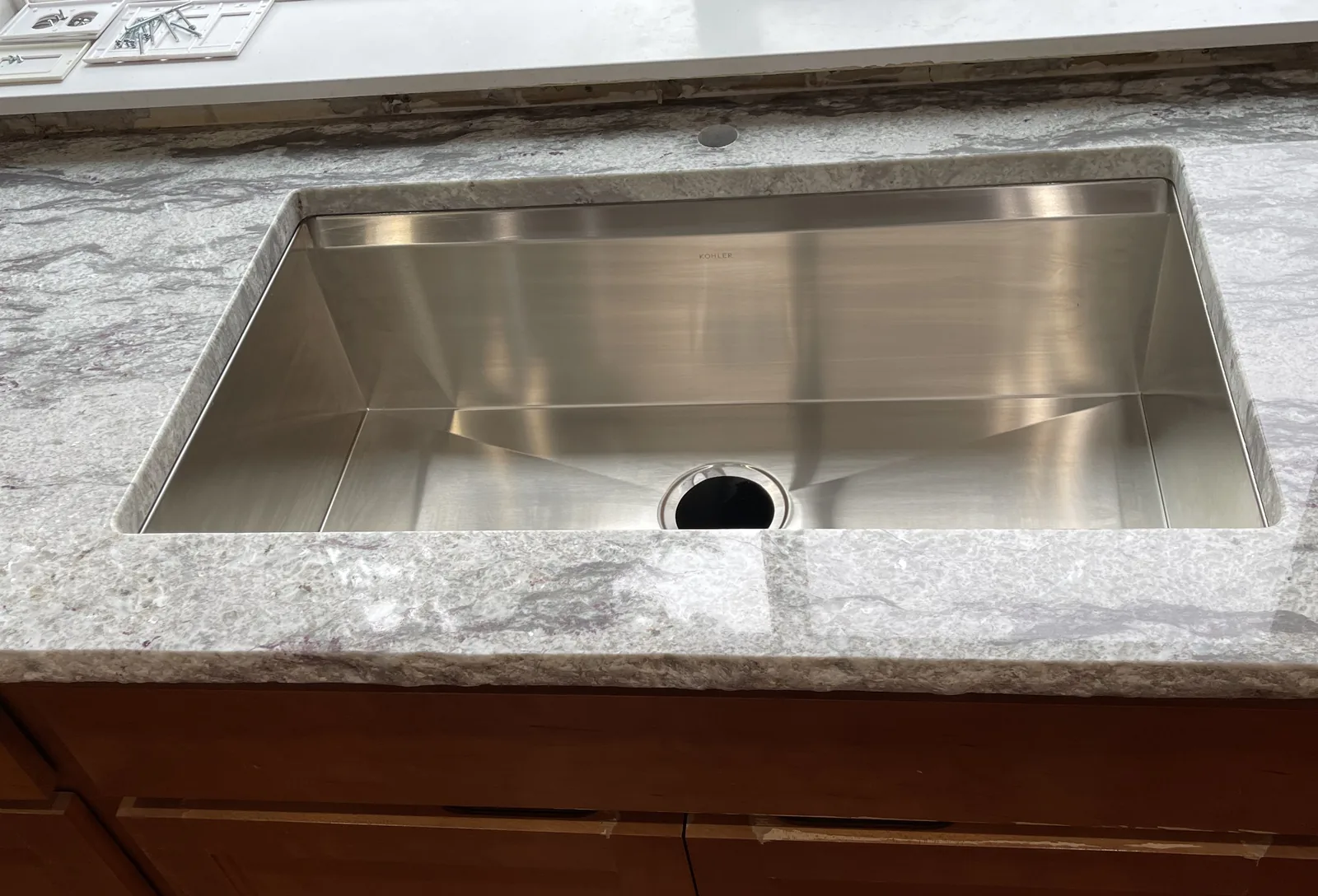
Your undermount sink came loose: why it happens and what fixes it
A sink that has dropped, tilted or pulled away from the stone is a mounting failure, not a stone failure. What to do in the first ten minutes, the seven things that cause it, and what a proper re-set actually involves.
Read article ↗︎Bring your ideas.
We’ll help with the next step.
Choose the next step that feels right for you.