

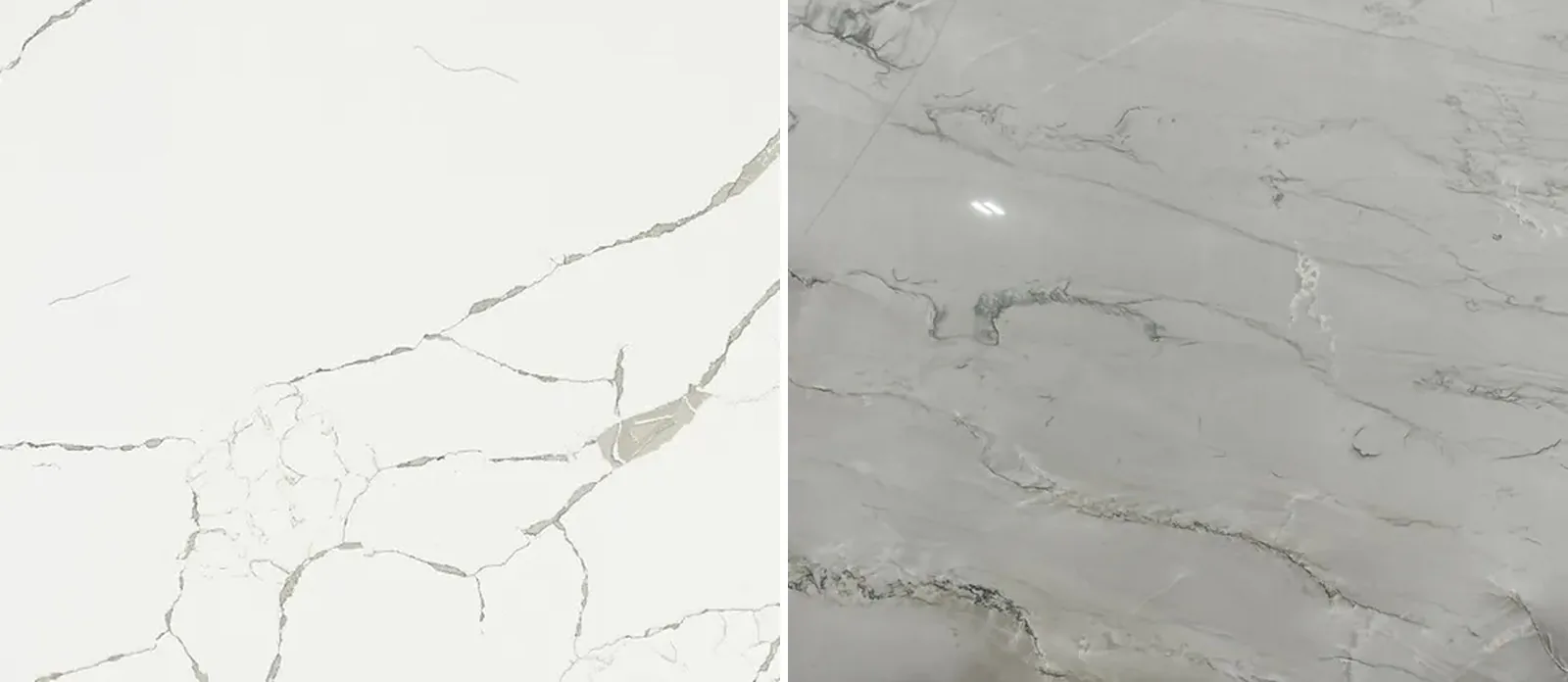
Quartz is an engineered slab made mostly of crushed quartz held together with resin. Quartzite is a natural stone cut from a quarry. Quartz needs no sealing and gives you a predictable pattern. Quartzite takes heat and sun better and every slab is one of a kind, but it needs sealing and costs more in most cases.
What quartz and quartzite actually are
The names are one letter apart, but they are not two grades of the same thing. They are made in completely different ways.
Quartz
Quartz countertops are made in a factory. Crushed natural quartz is mixed with resin and pigment, pressed into a slab and cured. The color is consistent from slab to slab, so the sample looks like the countertop you get. The resin makes quartz non-porous, and it is also what limits it around heat and direct sun.
Quartzite
Quartzite started as sandstone. Heat and pressure deep in the earth fused the sand grains into a dense, hard rock. It is quarried in blocks, sawn into slabs and polished. Nothing is added, so no two slabs look the same.
Seven differences side by side
These are the points that matter once you cook on it every day.
| What you will notice | Quartz | Quartzite |
|---|---|---|
| What it is | Engineered: crushed quartz plus resin | Natural stone from a quarry |
| Look | Even, repeatable pattern; what you see in the sample is what you get | Each slab is unique, with deeper movement and natural variation |
| Sealing | Never needs it | Needs it; how often depends on the slab |
| Stains and acids | Very stain resistant; lemon and wine do not etch it | Resists stains once sealed; true quartzite does not etch, but some slabs sold as quartzite do |
| Heat and sun | A hot pan can scorch or discolor the resin; strong sun can fade some colors | Handles heat and UV better, though a trivet is still the safe habit |
| Seams and pattern match | Easier to line up because the pattern repeats | Takes careful layout so the veins flow across the seam |
| Relative price | Wide range, from budget colors to premium designs | Usually higher than most quartz, with some overlap at the top |
Both resist everyday scratches well. The real question is which tradeoff you would rather live with: a little upkeep for natural stone, or none for a manufactured look.
Want a number before you decide? The budget planner lets you pick quartz or quartzite, enter your kitchen size, and see an estimated range on screen in a couple of minutes.
The catch: not every slab sold as quartzite is quartzite
Some stones sold under the quartzite name are actually marble or dolomite, which are softer and react to acid. In the trade they are often called soft quartzites. They can be beautiful, but they etch like marble.
Before you commit, ask for a sample of the exact stone and try two quick tests at home:
- Glass test. Drag the edge of a sample across a glass bottle. Real quartzite is harder than glass and will scratch it. A softer stone will not.
- Lemon test. Leave a few drops of lemon juice on the polished face for ten minutes, then wipe it off. A dull spot means the stone etches.
If a stone fails the lemon test and you still love it, choose it knowing it behaves like marble, and read our guide to stains and etch marks first. A honed or leathered finish hides etching better than polished, and our finish comparison explains why.
What moves the price on either one
The material sets the starting point. The rest of the scope moves the total:
- Area and slab count. How much stone the layout needs, and whether it fits in one slab or two.
- The specific color. Within quartz, a plain white and a heavily veined designer color are priced very differently. Quartzite varies by name and by the quality of each block.
- Thickness. 3cm costs more than 2cm in the same color.
- Edge profile. An eased edge is included. Ogee, bullnose and mitered edges add work. See our edge profiles.
- Cutouts. Every sink, cooktop and faucet hole is a cut.
- Tear-out and access. Removing old stone or tile, stairs and long carries all add time on install day.
For a line by line look at what a written quote should show, see how to read a countertop quote.
How to choose in practice: three questions
Will you seal a countertop once in a while? Sealing quartzite takes a few minutes. If you know you never will, choose quartz.
How much sun and heat does the counter see? A south-facing window over the counter, a range with no landing space, or a habit of setting pots straight down all point toward quartzite.
Do you want one of a kind, or exactly what you picked? If you want to pick your own slab, go see quartzite in person. If you want the countertop to match a sample with no surprises, choose quartz. Our quartz countertops and quartzite countertops pages show the colors we work with.
Still between the two? Text a photo of your kitchen to 206-653-4479 and tell us how you cook. We will tell you which one fits, free.
Frequently asked questions
Is quartzite better than quartz?
Neither is better for every kitchen. Quartzite is natural stone that handles heat and sun better and gives you a one of a kind slab, but it needs sealing. Quartz needs no sealing and gives a consistent look, but its resin can scorch under a hot pan. Choose by how you cook and how much upkeep you want.
Does quartzite need to be sealed?
Yes. Quartzite is dense, but it is still natural stone with some porosity, and the amount varies from slab to slab. A simple check is to leave a few drops of water on the counter for several minutes. If the stone darkens, it is time to reseal. Quartz never needs sealing.
Can you put a hot pan on quartz or quartzite?
Use a trivet on both. Quartz is the more sensitive one, because the resin in it can scorch or discolor under a hot pan. Quartzite handles heat better, but a sudden temperature change can still stress any stone.
How can I tell if a slab is real quartzite?
Ask for a sample of the exact stone. Real quartzite is harder than glass, so it will scratch a glass bottle, and lemon juice left on it will not leave a dull spot. A stone that fails those tests is likely marble or dolomite sold under the quartzite name, and it will etch like marble.
Which costs more, quartz or quartzite?
Quartzite usually costs more than most quartz, but the ranges overlap: premium quartz colors can cost as much as entry quartzite. Size, thickness, edge, cutouts and tear-out move the total as much as the material does. The budget planner gives you a range for your kitchen with either one.
Not sure which one? Send a photo
Take a photo of your kitchen in daylight and tell us which colors caught your eye. We will tell you whether quartz or quartzite fits the way you live, free. Top Granite is a family business in Lynnwood serving greater Seattle and the Eastside. We fabricate and install quartz, granite, quartzite, marble and soapstone, we are rated 5.0 on Google, licensed in Washington, with a 2-year labor warranty and a free in-home visit to measure and quote. Most jobs take 5 to 12 business days from template to install. Call or text 206-653-4479, use the contact page, or put a range on your project with the budget planner.
What could your
countertops cost?
Answer a few questions about your space and material and get an estimated range in about two minutes. Your formal quote follows a laser template and a review of the scope.
Your ideas in. A clearer next step out.
Rather talk it through? 206-653-4479 ↗︎What would you like to change?
Which material are you leaning toward?
Build my countertop estimateChoose your details and see your estimated range.
Related reading.
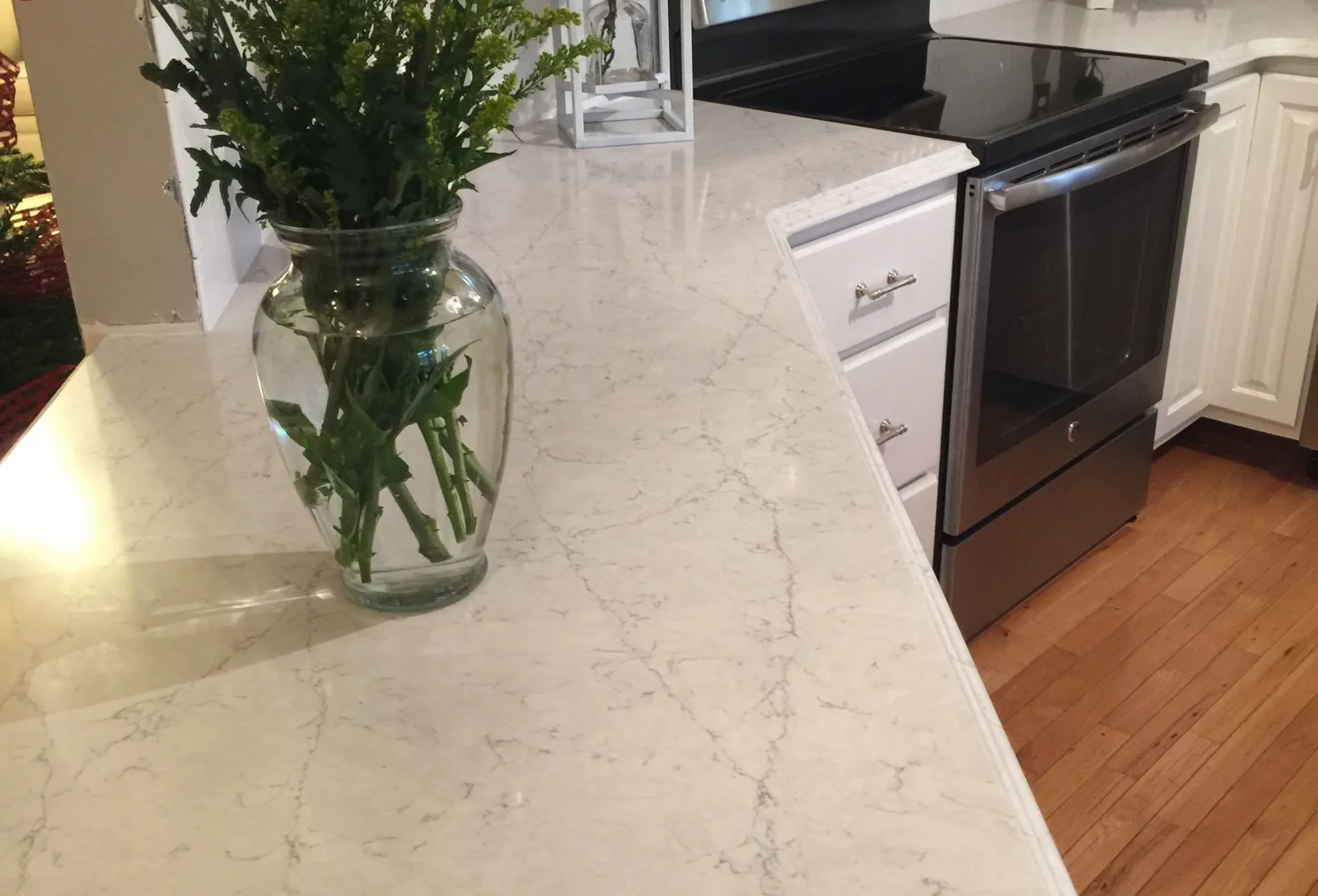
Countertop stains and etch marks: what comes out and what does not
A stain soaked in and can often be drawn back out at home. An etch mark ate the polish and has to be worked back by hand. How to tell them apart, the water test for your sealer, and what needs a repair visit.
Read article ↗︎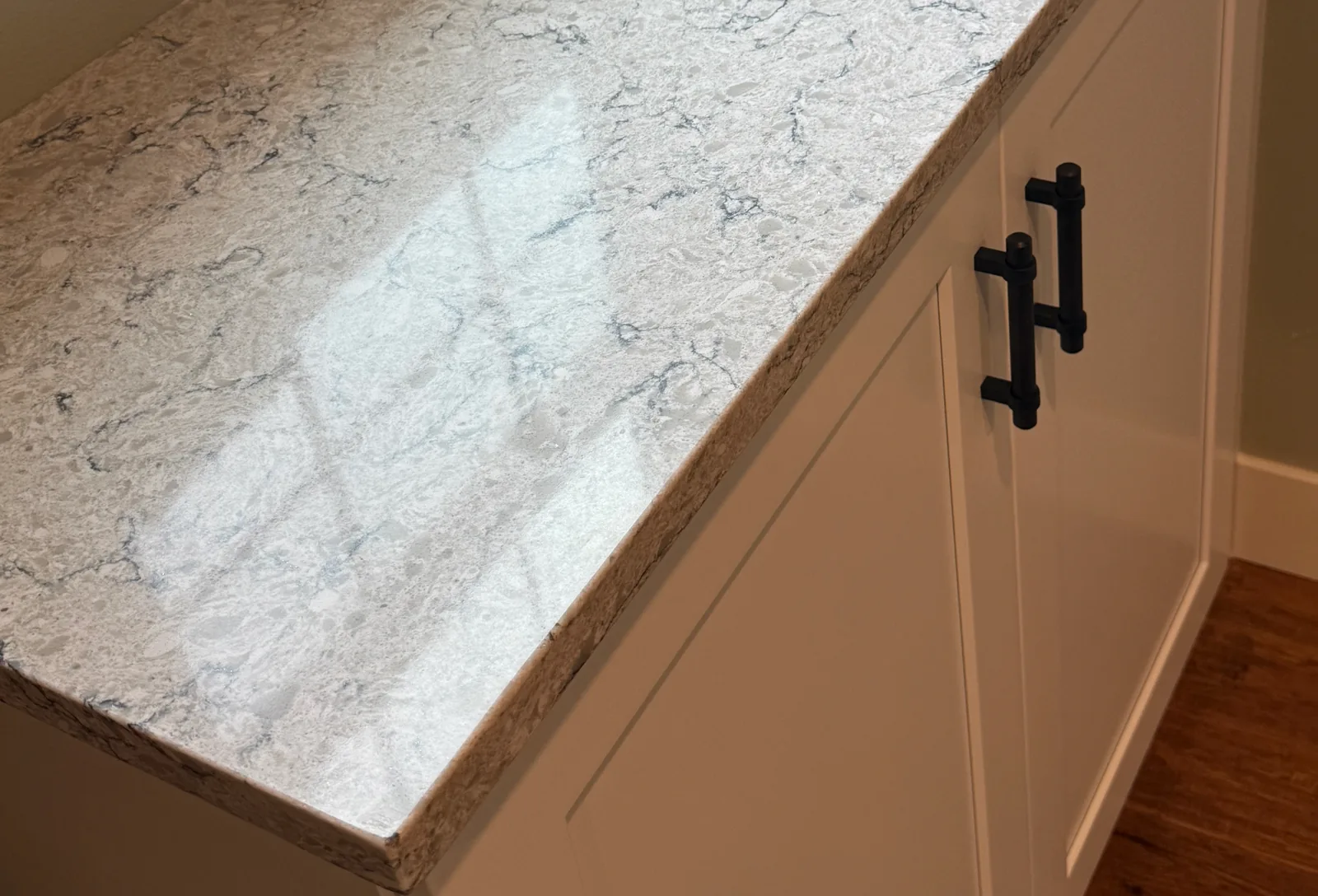
Countertop refinishing: what 7 surfaces can actually get
Refinishing means restoring the finish on stone, or painting a coating over laminate and tile. What 7 surfaces can actually get, three checks to see if yours is really worn, and how to decide between refinishing and replacing.
Read article ↗︎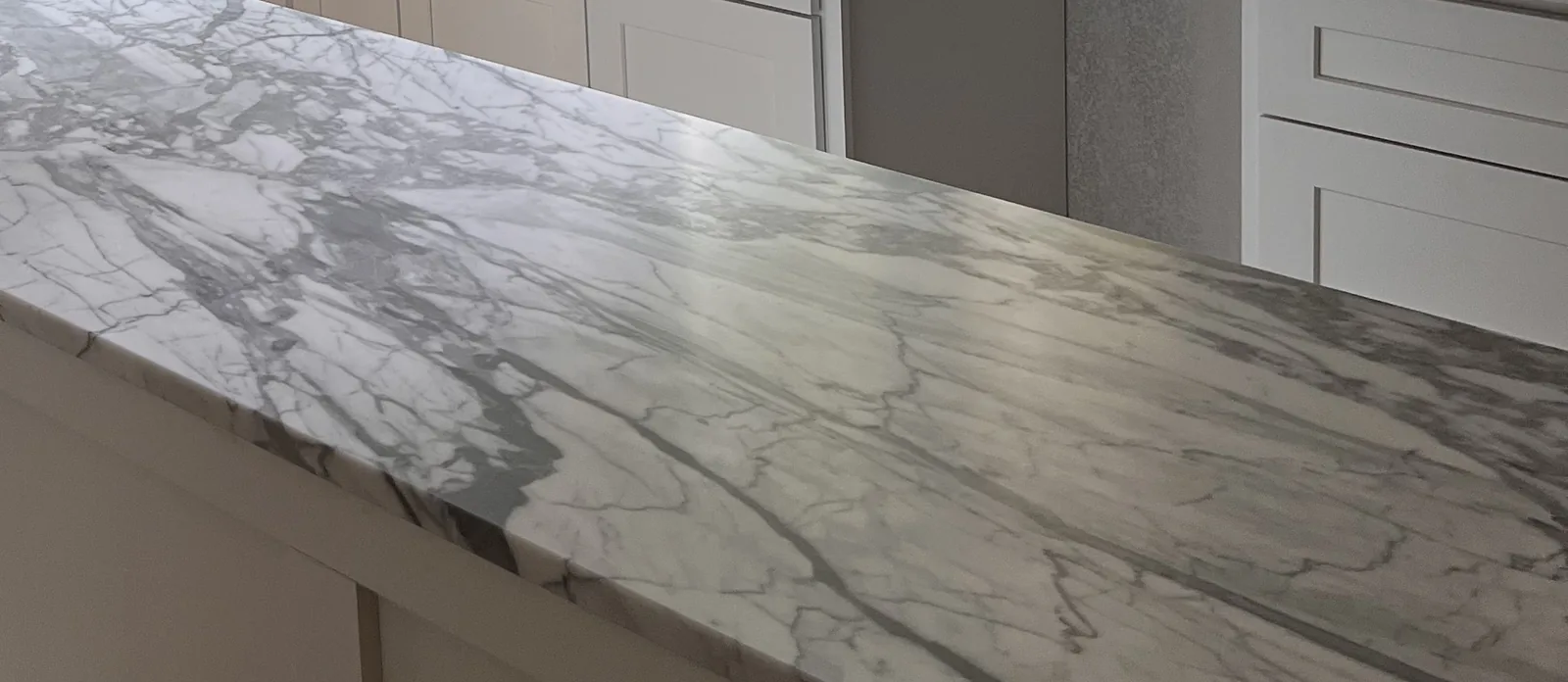
Marble countertop repair: what fixes 7 kinds of damage
Etching, chips, cracks and stains each get a different answer on marble. What every kind of damage can get, why polished and honed tops repair differently, and when a fix will still show.
Read article ↗︎Bring your ideas.
We’ll help with the next step.
Choose the next step that feels right for you.