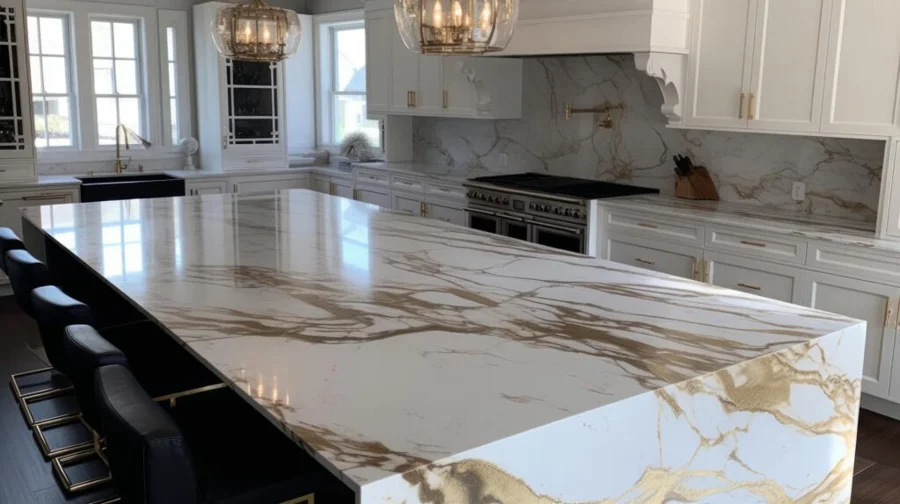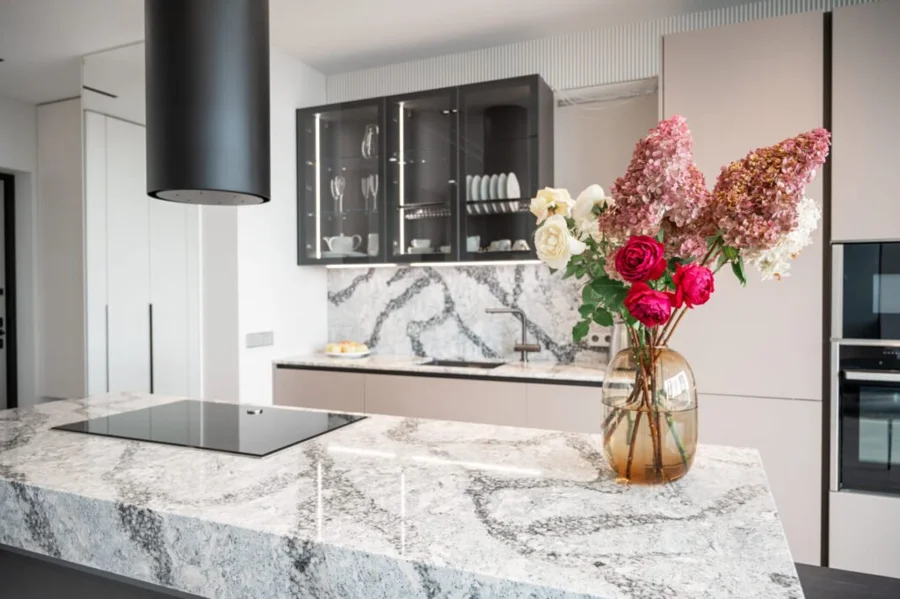

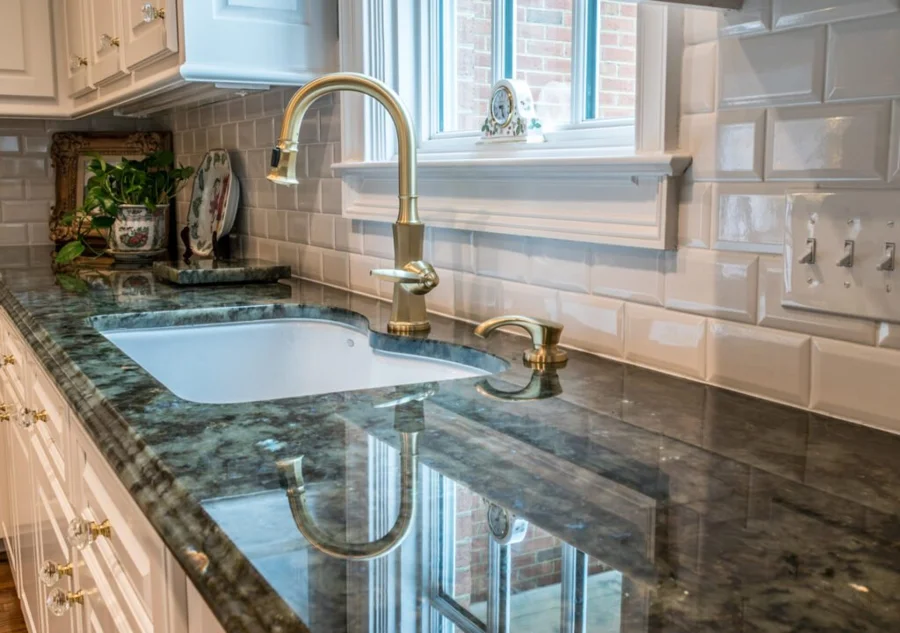
A labradorite countertop is chosen for its changing flashes of color, often blue, green, or gold, within a natural stone surface. The name refers to a feldspar mineral, so it does not by itself identify every property of the finished slab. Before choosing one, confirm the stone's identity, suitability, condition, and care requirements with the supplier and your countertop team.
What makes labradorite look different?
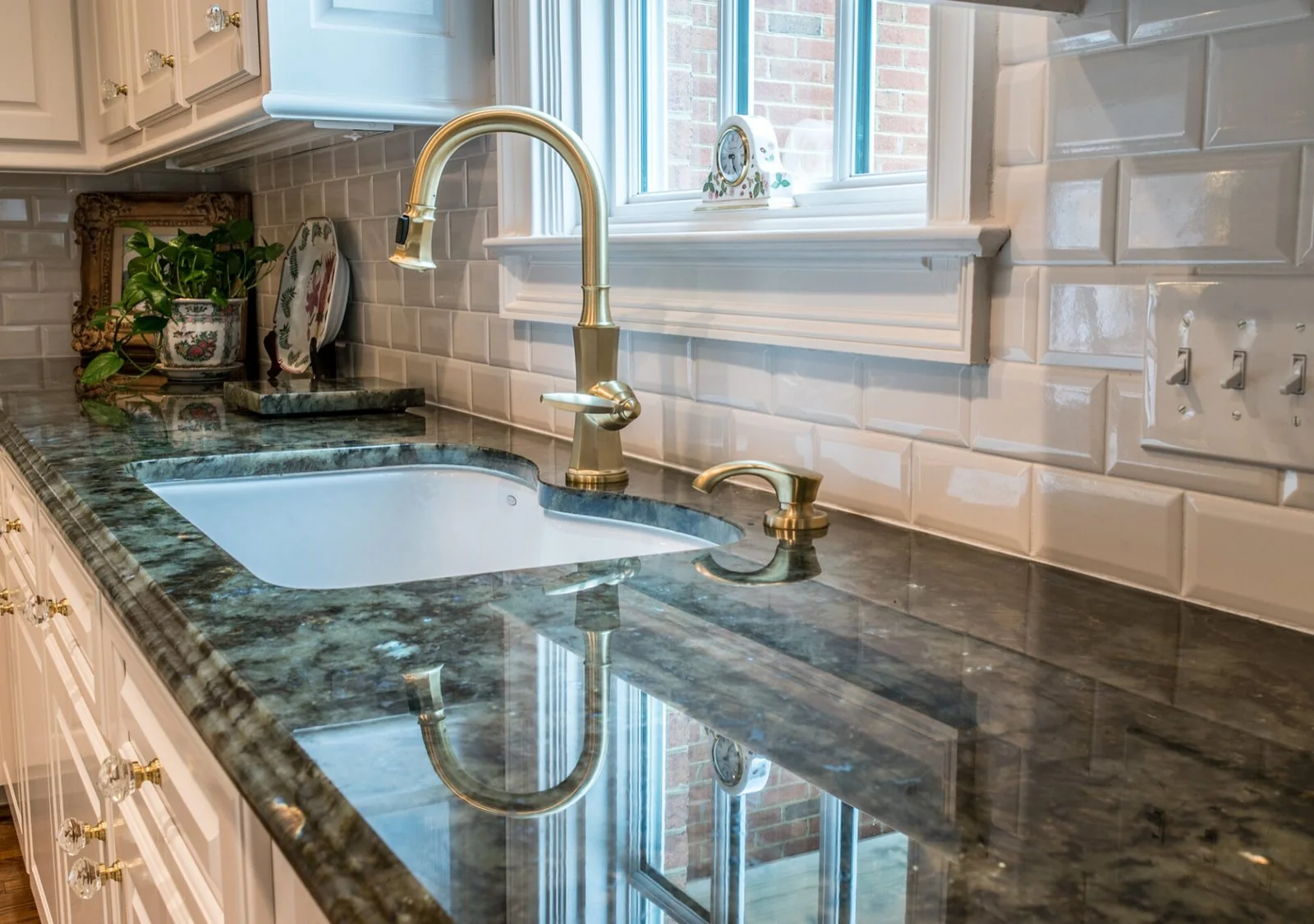
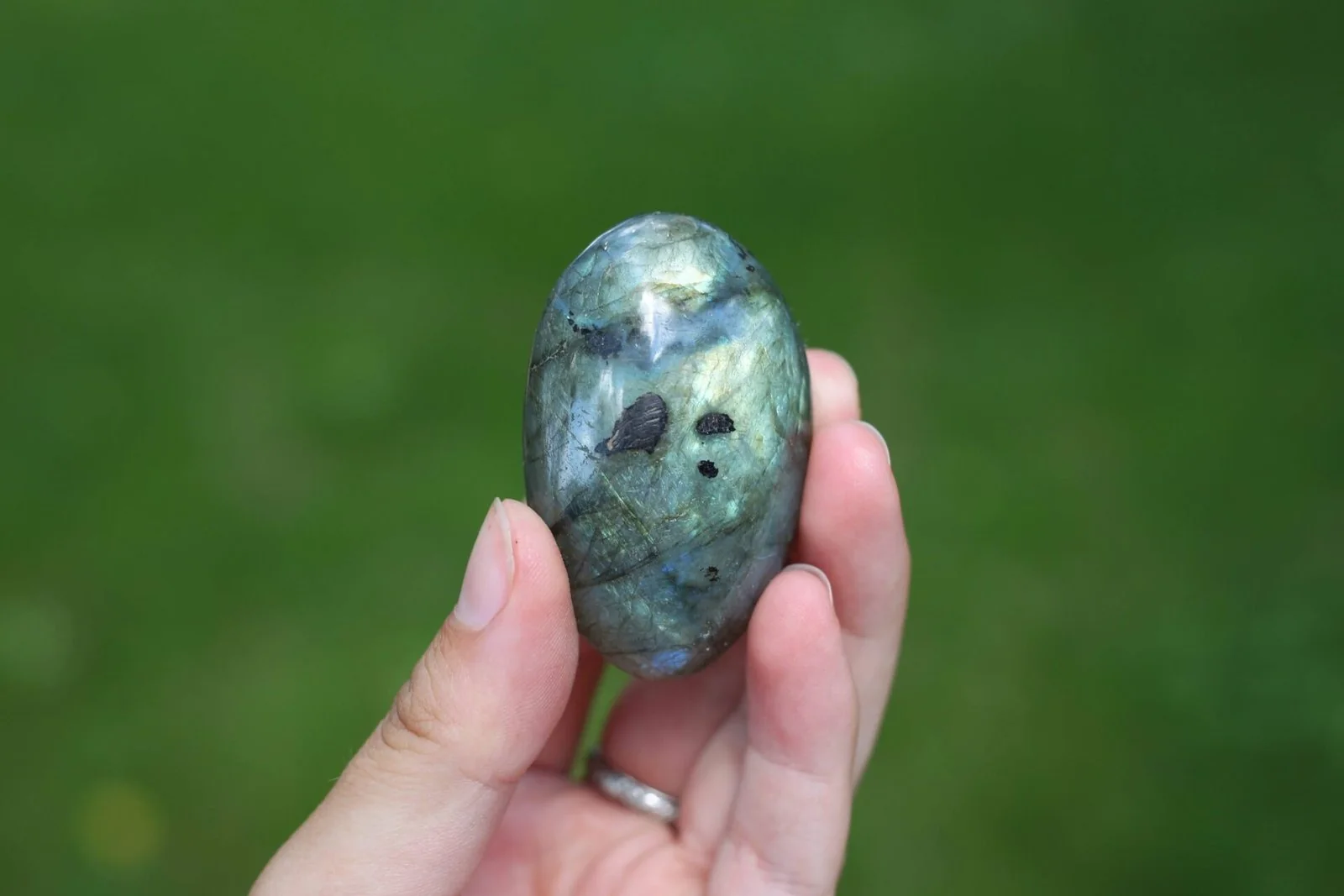
Labradorite can display an optical effect called labradorescence. Its internal structure interacts with light to produce flashes of color that change with the viewing angle. The Gemological Institute of America explains this effect using examples from Madagascar and Finland.
That movement gives the material a different visual character from a printed or consistently colored surface. One part of a slab may show a strong blue flash while another appears quieter under the same lighting.
The effect is also why a single photograph is not enough to choose a slab. The kitchen lighting, viewing direction, and placement of the countertop can change how much of that color you see.
Understand the slab behind the trade name
A mineral name and a stone supplier's commercial name serve different purposes. Do not assume that every slab marketed as labradorite is the same rock, has the same treatment, or behaves exactly like a familiar granite.
Ask for the supplier's identification and technical information for the specific material. Confirm whether resin, mesh backing, or other treatments are present and whether the slab is recommended for your intended application.
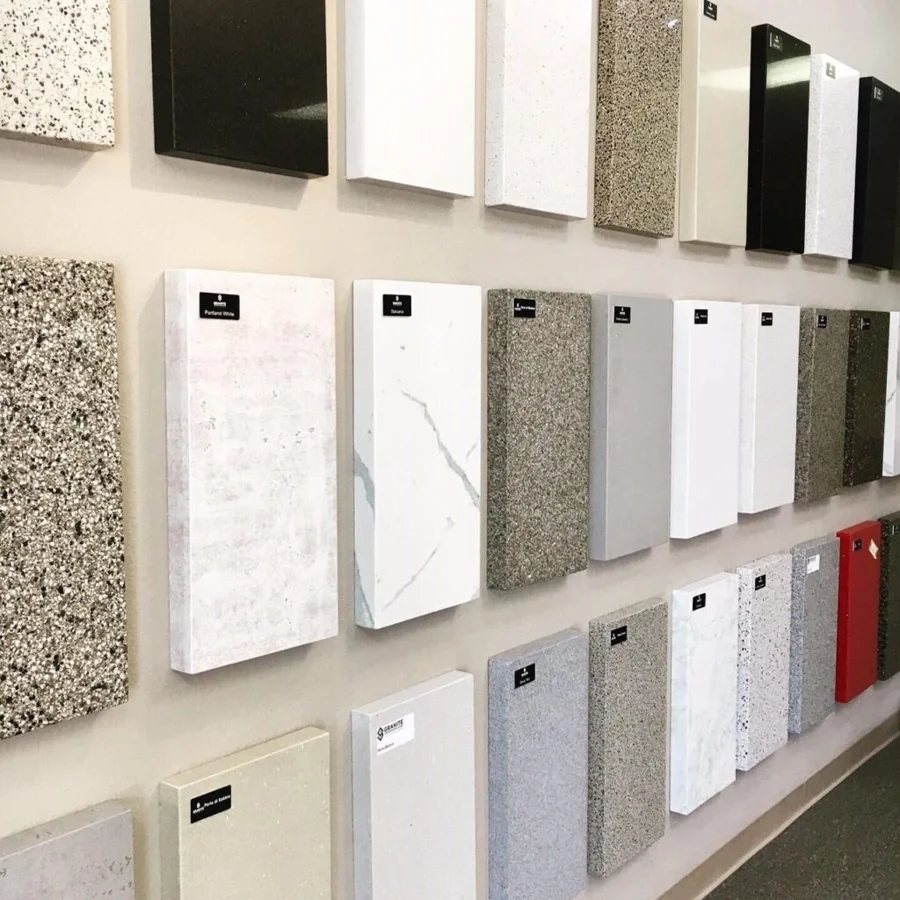
If you are also considering granite countertops or quartzite countertops, compare the actual slabs and documented characteristics. A trade label alone cannot settle questions about absorption, fabrication, or performance.
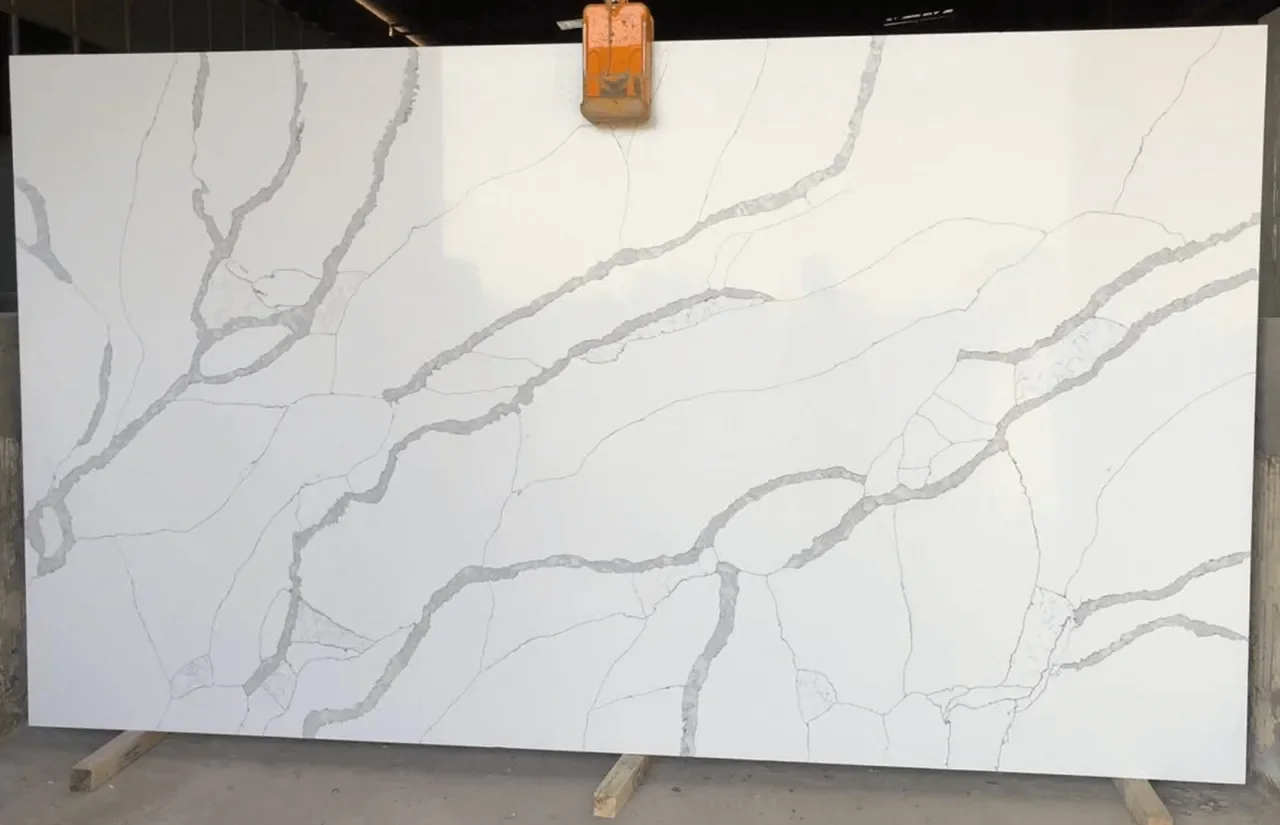
This is especially important when you find the same photograph under different material names online. Use it to explain the appearance you like, then verify what is actually available.
Three ways to make the color work in your kitchen
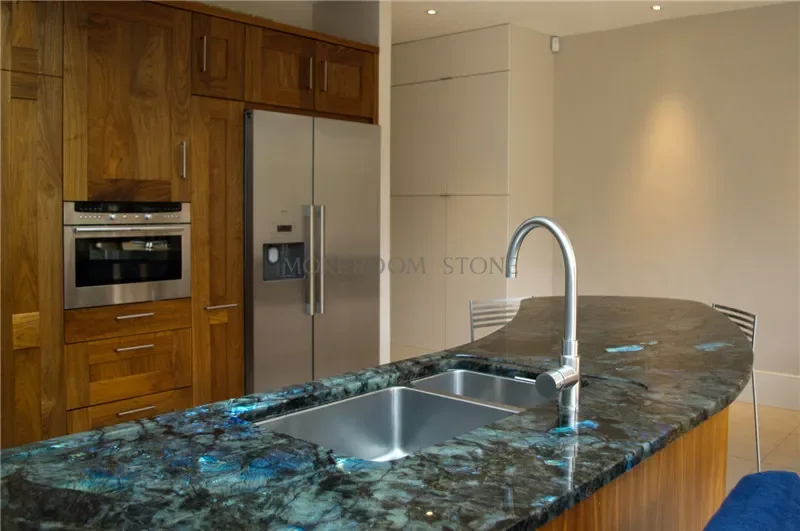
1. Let one surface carry the strongest pattern
An expressive countertop can give a simple kitchen its focal point. Pairing it with quieter cabinets or a restrained backsplash leaves room to notice the mineral pattern.
If your floor already has pronounced movement, compare the two together. You may prefer a more subdued portion of the slab or a smaller application instead of covering every surface.
2. Review the stone from normal viewing positions
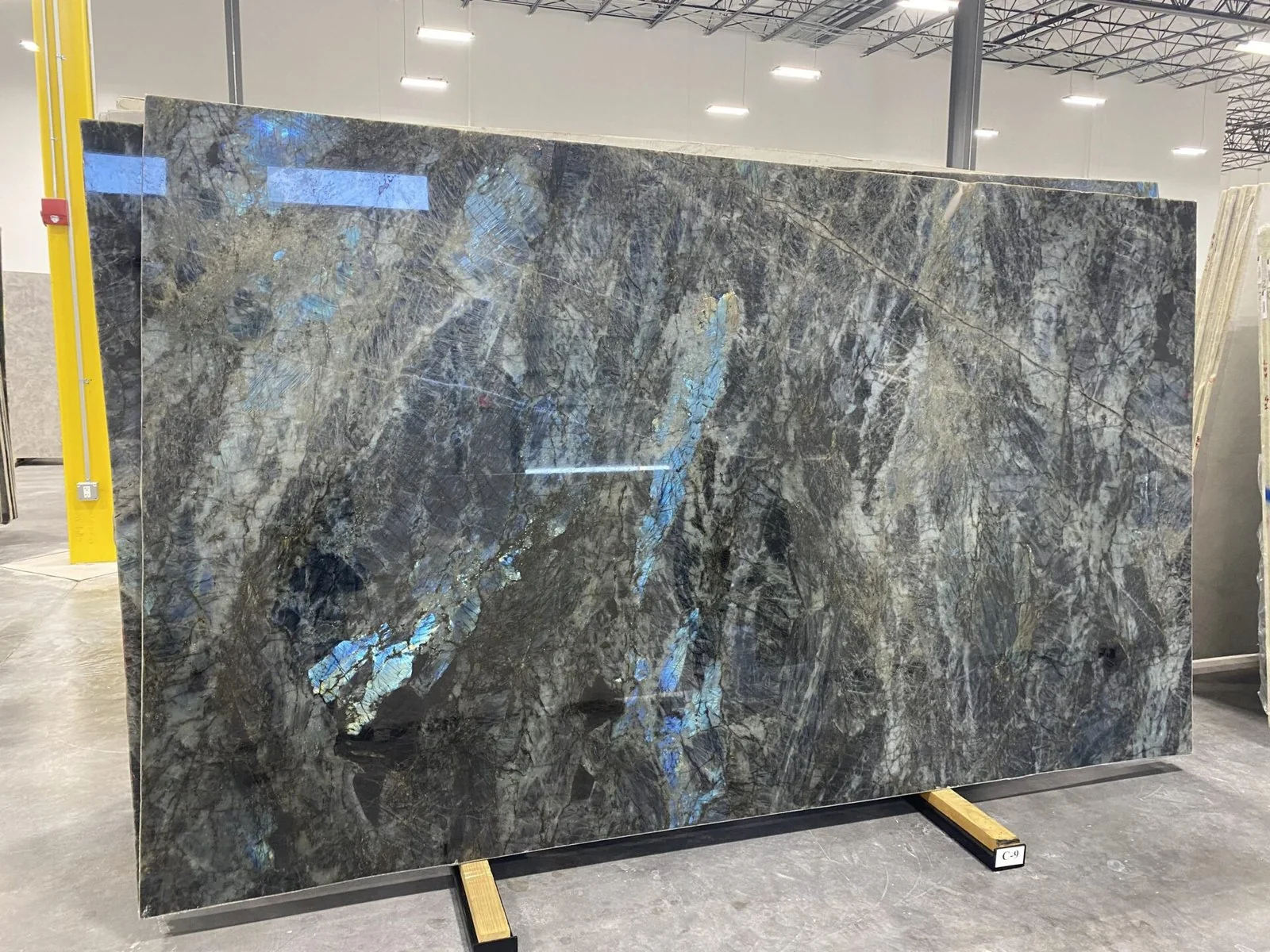
Look at the slab from more than one angle, and ask how its orientation will translate to a horizontal countertop. A color flash visible on a vertical display may read differently once the stone lies flat.
Think about the views from the doorway, seating area, and sink. Those are the angles you will experience repeatedly after installation.
3. Plan the layout around the parts you love
Mark the areas of the slab that draw your attention before the final layout is approved. A sink or cooktop cutout may otherwise remove a section that mattered to your selection.
For a waterfall panel, discuss orientation and corner transitions. Natural variation means that adjacent pieces will not necessarily create a perfectly continuous effect.
Labradorite and quartz: different reasons to choose each
Engineered quartz countertops can be useful when you want to compare more controlled design options and straightforward routine care. Labradorite-bearing stone appeals to someone who values the particular character of an individual natural slab.
Neither choice should be reduced to a claim that one is always stronger or more luxurious. Compare the exact materials against the way you will use the room.
| Consideration | Labradorite-bearing natural stone | Engineered quartz |
|---|---|---|
| Appearance | Individual mineral patterns and angle-dependent color | Manufactured designs with variation by product |
| Selection process | Review the actual slab and its orientation | Review samples and the selected full-slab design |
| Sealing | Determine from the stone and supplier guidance | Generally does not require routine sealing |
| Heat and impact | Follow stone-specific guidance and protect exposed edges | Protect from excessive heat and impact |
| Project cost | Depends on the particular slab and fabrication requirements | Depends on the design, slab use, and project scope |
What to ask about durability and care
Avoid treating a striking appearance as evidence of a particular performance rating. Ask how the selected stone responds to everyday spills and which cleaning products are appropriate for its finish and treatments.
The Natural Stone Institute's care guidance recommends suitable cleaning products and explains that sealing needs depend on the stone. Sealing can improve stain resistance; it does not make a countertop impervious to all damage.
Use cutting boards and trivets as part of a practical care routine. Pay attention to exposed edges around sinks, where a heavy pot can strike the surface.
Ask for written care instructions before installation. If the supplied guidance conflicts with a generic online tip, clarify the recommendation for your exact material rather than experimenting with abrasive or acidic cleaners.
Plan fabrication and installation around the material
A distinctive slab needs a layout that works structurally as well as visually. Countertop dimensions, sink openings, supports, and seam positions should be discussed together.
The team also needs to evaluate access into the home. A piece that can be cut from the slab still has to travel through the planned route and be positioned without compromising it or the surrounding space.
Our countertop installation service begins with those project requirements. Confirm that a particular specialty material can be sourced and accommodated before committing to it.
Top Granite manages the fabrication and uses our own installation team. Our 5-year workmanship warranty is separate from the natural characteristics of the material and any supplier coverage; review the written project terms.
Budget for the finished result
The final scope includes more than the surface area of the countertop. Slab selection, usable layout, edges, cutouts, supports, removal, and installation conditions all contribute.
If you are replacing an existing counter, tell the team which cabinets, appliances, and backsplash will remain. Keeping those elements can shape the installation plan just as much as the stone does.
For a smaller feature, ask whether an appropriate available piece could meet the dimensions. Treat availability as something to confirm, rather than assuming a rare-looking surface can be reordered later to match.
Frequently asked questions
Is labradorite the same as quartzite?
No. Labradorite is a feldspar mineral, while quartzite is a rock type. Commercial slab names can be confusing, so ask the supplier to identify the specific stone and provide its technical information.
Will the countertop always show bright blue flashes?
No. The visible effect depends on the slab, lighting, and viewing angle. Review the material from several positions and discuss how its orientation will change when installed horizontally.
Does labradorite need sealing every year?
There is no universal annual schedule. Follow the recommendations for the particular stone, finish, and any treatments, and ask the supplier or countertop professional how to assess its sealing needs.
Explore a distinctive surface with a clear plan
Use the Budget planner to begin outlining your countertop project and priorities. To discuss specialty stone availability and suitability, contact Top Granite at 206-653-4479, serving greater Seattle and the Eastside from Lynnwood.